Key Takeaways
- India remains a leading destination for mobile app development due to deep technical talent, cost efficiency, and strong experience across industries.
- The best app development partner depends on your project type, not just rankings, so match the company’s strengths to your actual needs.
- App costs in India vary widely based on complexity, platform choice, integrations, and the engagement model you pick.
- A clear evaluation process covering portfolio, communication, post-launch support, and security protects you from expensive mistakes.
- Logical Wings builds business apps around real workflows and measurable outcomes rather than feature checklists.
Choosing where to build your mobile app is one of the few early decisions that can quietly decide whether your product ships on time or stalls for months. India sits at the center of that decision for a growing number of global businesses, and picking the right app development company here means weighing technical depth, communication, and domain fit, not just hourly rates. This guide walks through why India keeps attracting app projects, which companies deserve a shortlist in 2026, and how to run a selection process that actually protects your budget.
Why Businesses Keep Choosing an app development company in India
The pull toward India isn’t only about cost, though cost still matters. What’s changed over the past few years is the depth of specialization. You can now find teams that have shipped dozens of apps in fintech, healthcare, logistics, or retail, which means they understand the regulatory edge cases and user behaviors specific to those domains before you explain them.
Talent availability is the other half of the equation. India produces a large, continuous stream of engineers fluent in native iOS and Android, cross-platform frameworks like Flutter and React Native, and the backend systems that modern apps depend on. For a startup founder or an SME owner, that translates to flexibility: you can staff a small focused team or scale to a full product squad without restarting your search.
Time zone overlap, often framed as a drawback, works in your favor when managed well. A team in India can run overnight development cycles against a US schedule, so progress compounds while your office sleeps. The companies worth hiring have refined this into predictable daily handoffs rather than chaotic async confusion.
Top Mobile App Development Companies in India to Consider in 2026
No single company is right for every project. A consumer app chasing millions of downloads has different needs than an internal operations tool for a mid-sized manufacturer. The list below reflects distinct strengths rather than a strict ranking, so weigh each against your own requirements.
Logical Wings focuses on business-centric mobile applications where the app has to fit into real operational workflows, integrate with existing systems, and produce measurable outcomes. This makes it a strong fit for SMEs, startups, and established businesses that want an app tied to a clear business goal rather than a feature wishlist. The emphasis is on understanding your process first, then building around it.
Tata Consultancy Services (TCS) suits large enterprises with complex, multi-system environments and strict compliance demands. If your app is one piece of a sprawling digital transformation program, a firm of this scale brings the governance and integration muscle that smaller shops can’t match.
Infosys fits organizations that need app development bundled with broader consulting, cloud migration, or legacy modernization. Their strength is handling projects where the mobile app is deeply entangled with enterprise architecture decisions.
Tech Mahindra works well for telecom, networking, and connectivity-heavy applications, drawing on deep domain roots in those sectors. For projects that lean on carrier integrations or IoT connectivity, that specialization shortens the learning curve.
Mindtree (LTIMindtree) appeals to mid-to-large companies wanting digital product engineering with a focus on user experience and data-driven features. They tend to do well on consumer-facing apps that need polish alongside engineering rigor.
Hyperlink InfoSystem and similar high-volume studios suit buyers who want a wide service menu and a large bench, useful when you need to spin up multiple apps or variations quickly. The trade-off is that process consistency can vary across teams, so vet the specific squad assigned to you.
When you shortlist, resist the urge to pick purely on brand recognition. A smaller, focused app development company in India often gives a startup more attention and faster decision-making than a global giant where your project may be a rounding error.
What Mobile App Development Services Should You Look For?
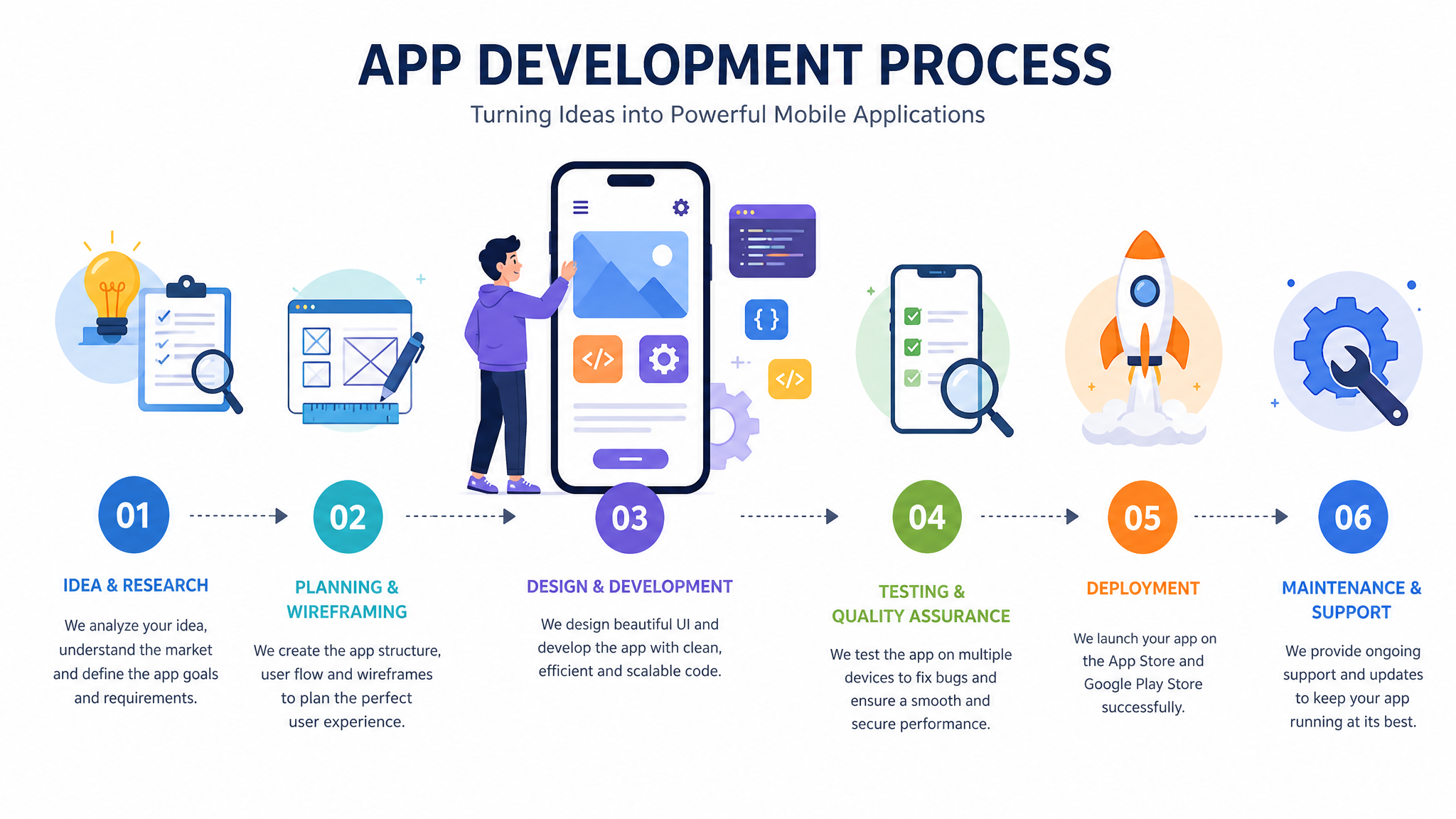
The phrase “app development” hides a lot of distinct work, and a capable partner should cover the full arc rather than just writing code. Here’s what genuinely matters when you compare service offerings:
- Discovery and product strategy that pressure-tests your idea before a line of code is written, including user flows, platform choices, and a realistic feature scope for your first release instead of an inflated wishlist.
- UI/UX design grounded in how your actual users behave, not just attractive screens, because a beautiful app that confuses people still fails in the store ratings.
- Native and cross-platform development with an honest recommendation about which fits your budget and performance needs, rather than a default push toward whatever the team prefers to build.
- Backend and API engineering that can handle your expected load and integrate cleanly with the CRMs, payment systems, or internal tools your business already runs on.
- Quality assurance and device testing across the fragmented Android ecosystem and multiple iOS versions, since a bug that only appears on older devices can tank your reviews fast.
- Post-launch support and maintenance covering OS updates, security patches, and iterative improvements, because launch day is the start of the work, not the end.
A partner missing any of these isn’t automatically disqualified, but you need to know who fills the gap and whether that cost lands on you later.

How to Choose the Right App Development Agency for Your Project
Discussing with an app development agency comes down to matching evidence against your specific risk points, not collecting the most impressive sales deck. Work through these checks before signing anything.
Start with portfolio relevance. A team that has shipped apps in your industry or with similar technical complexity carries hard-won knowledge you won’t have to pay to teach them. Ask to see live apps you can download, not just mockups, and look at their recent store reviews for signs of stability and support quality.
Communication structure deserves as much scrutiny as technical skill. Find out who your day-to-day point of contact is, how often you’ll see working builds, and what project management tools they use. Weekly demos of real functionality beat long status reports every time, because they expose problems while they’re still cheap to fix.
Then probe how they handle ownership and security. Confirm you retain full source code and IP, understand their approach to data protection and compliance for your market, and get clarity on what happens if you part ways mid-project. For an app development company for SMEs, these details often get glossed over in friendly early calls, so put them in writing.
Finally, weigh their post-launch commitment. A team eager to disappear after shipping is a warning sign. The partners worth keeping treat the first few months after launch as a tuning period and have a clear maintenance arrangement ready before you ask.
What Affects the Cost of Mobile App Development in India?
Pricing conversations go sideways when buyers ask “how much for an app” as if there’s a sticker price. Cost is driven by a handful of concrete factors, and understanding them lets you shape scope intelligently instead of just reacting to a quote.
| Cost Factor | What Pushes It Up | How to Control It |
|---|---|---|
| App complexity | Custom logic, real-time features, heavy animations | Launch a focused first version, add complexity later |
| Platform choice | Separate native iOS and Android builds | Consider cross-platform if performance allows |
| Integrations | Payments, third-party APIs, legacy systems | Prioritize only the integrations users need at launch |
| Design depth | Custom illustrations, complex interactions | Reuse proven patterns where originality adds no value |
| Team seniority | All-senior squads, specialized skills | Blend senior and mid-level engineers thoughtfully |
| Engagement model | Fixed-scope rigidity vs. open-ended time and material | Match the model to how defined your requirements are |
The engagement model deserves a closer look. Fixed-price contracts give budget certainty but punish change, which hurts when your understanding of the product evolves mid-build, as it almost always does. Dedicated team or time-and-material arrangements cost more to govern but absorb change gracefully. For a well-defined internal tool, fixed scope can work; for an evolving consumer product, flexibility usually pays for itself.
One honest caution: the cheapest quote frequently becomes the most expensive project. Rock-bottom pricing often signals junior-heavy teams, thin testing, or scope that quietly excludes the work that actually makes an app usable. Judge value against outcomes, not just the invoice.
How Logical Wings Approaches Business App Development
Logical Wings starts from a simple position: an app is a tool to move a business metric, not a trophy. Before scoping features, the team digs into what the app is supposed to change, whether that’s cutting a manual process, opening a new revenue channel, or giving your field staff something faster than a spreadsheet.
That process-first approach shapes everything downstream. Instead of building a long feature list and hoping it sticks, the focus lands on a lean first release that solves the core problem, ships to real users, and generates feedback you can act on. For SMEs and startups especially, this keeps initial investment disciplined and reduces the risk of pouring budget into features nobody opens.
Integration gets treated as a first-class concern rather than an afterthought. Most business apps have to talk to tools you already run, and Logical Wings plans those connections early so they don’t become the thing that derails your timeline near the end. Paired with clear communication and a maintenance relationship that continues past launch, the goal is an app that keeps earning its place in your operations.
Making the Right Choice for Your Mobile Application Project
The best decision here is rarely the flashiest name or the lowest number. It’s the partner whose strengths line up with your project’s actual risks, who communicates in a way you can live with for months, and who is transparent about trade-offs instead of promising everything.
Shortlist three or four companies, hand each the same brief, and compare not just the proposals but how they ask questions and push back on your assumptions. The team that challenges your scope thoughtfully is usually the one that will protect your budget once the work begins. If you want a partner that ties the app directly to a business outcome and stays engaged after launch, start that conversation with Logical Wings and bring your real operational problem, not just a feature list.
Frequently Asked Questions
How long does it take to build a mobile app with a company in India?
A focused first release typically takes three to five months, depending on complexity, number of integrations, and how clearly the requirements are defined at the start. Rushing this timeline usually means cutting testing, which costs more to fix after launch.
Should I choose native or cross-platform development?
Cross-platform frameworks like Flutter or React Native suit most business apps and startups because they share code across iOS and Android, lowering cost. Choose native when you need peak performance, heavy device-level features, or the most polished platform-specific experience.
Will I own the source code and intellectual property?
A reputable app development company should transfer full source code and IP ownership to you, and this must be stated clearly in your contract. If a vendor is vague about ownership, treat it as a serious warning sign before signing.
Is an Indian app development company a good fit for a small business or startup?
Yes, provided you pick a team sized to your project rather than a giant where you become a minor account. Smaller, focused studios often give SMEs faster decisions, closer attention, and pricing that fits an early-stage budget.