Key Takeaways
- Digital product development has shifted from waterfall project delivery to continuous, user-driven iteration powered by cloud, AI, and real-time data.
- The modern process follows discovery, design, build, launch, and ongoing measurement, with each loop informing the next release.
- Trends for 2026-27 center on AI-assisted engineering, composable architecture, and tighter product-analytics feedback than ever before.
- Choosing the right development partner depends on how they handle discovery, technical trade-offs, and post-launch iteration, not just how fast they ship.
Twenty years ago, shipping software meant locking requirements, disappearing for a year, and hoping the market still wanted what you built. That model is gone. Today, digital product development is a continuous conversation between what users do, what data reveals, and what teams decide to build next. The result is faster feedback, smaller bets, and products that reshape themselves while they’re live rather than after a painful post-mortem.
This piece walks through how we got here, where the discipline is heading through 2026-27, and the practical process behind building a digital product that actually earns its place in people’s workflows.
What Digital Product Development Actually Means Now
A digital product is any software-driven experience that delivers ongoing value: a SaaS platform, a mobile app, an internal operations tool, an API that other teams build on. Development is the full cycle of research, design, engineering, release, and refinement that keeps that product useful over time.
The word that matters most is ongoing. A website gets built and launched. A product gets built, launched, measured, and rebuilt in a loop that never really closes. This is the core difference between project thinking and product thinking. Project thinking asks, “Did we deliver the scope?” Product thinking asks, “Is this still solving the problem, and what did last week’s usage data tell us?”
That shift changes everything downstream: how teams are staffed, how success is measured, and how budgets are planned. Instead of a fixed statement of work with a hard end date, you’re funding a capability that compounds.
How Digital Product Development Evolved From Projects to Continuous Delivery
The arc is worth understanding because it explains why certain practices are now non-negotiable.
In the early era, teams used waterfall: define requirements, design, build, test, release, each phase handed off to the next. It worked when requirements were stable and shipping was expensive. It failed when markets moved faster than release cycles.
Agile broke the work into short iterations and put working software in front of users sooner. Then DevOps collapsed the wall between building and running software, making frequent, low-risk deployments routine. Cloud infrastructure removed the need to provision servers months ahead of demand. And product analytics gave teams something they never had before: evidence about what users actually do, not what they claimed they’d do in a requirements meeting.
Put those together and you get the current reality. A small team can ship a change on Tuesday, watch the data on Wednesday, and decide whether to double down or roll back on Thursday. The feedback loop that once took a year now takes days.
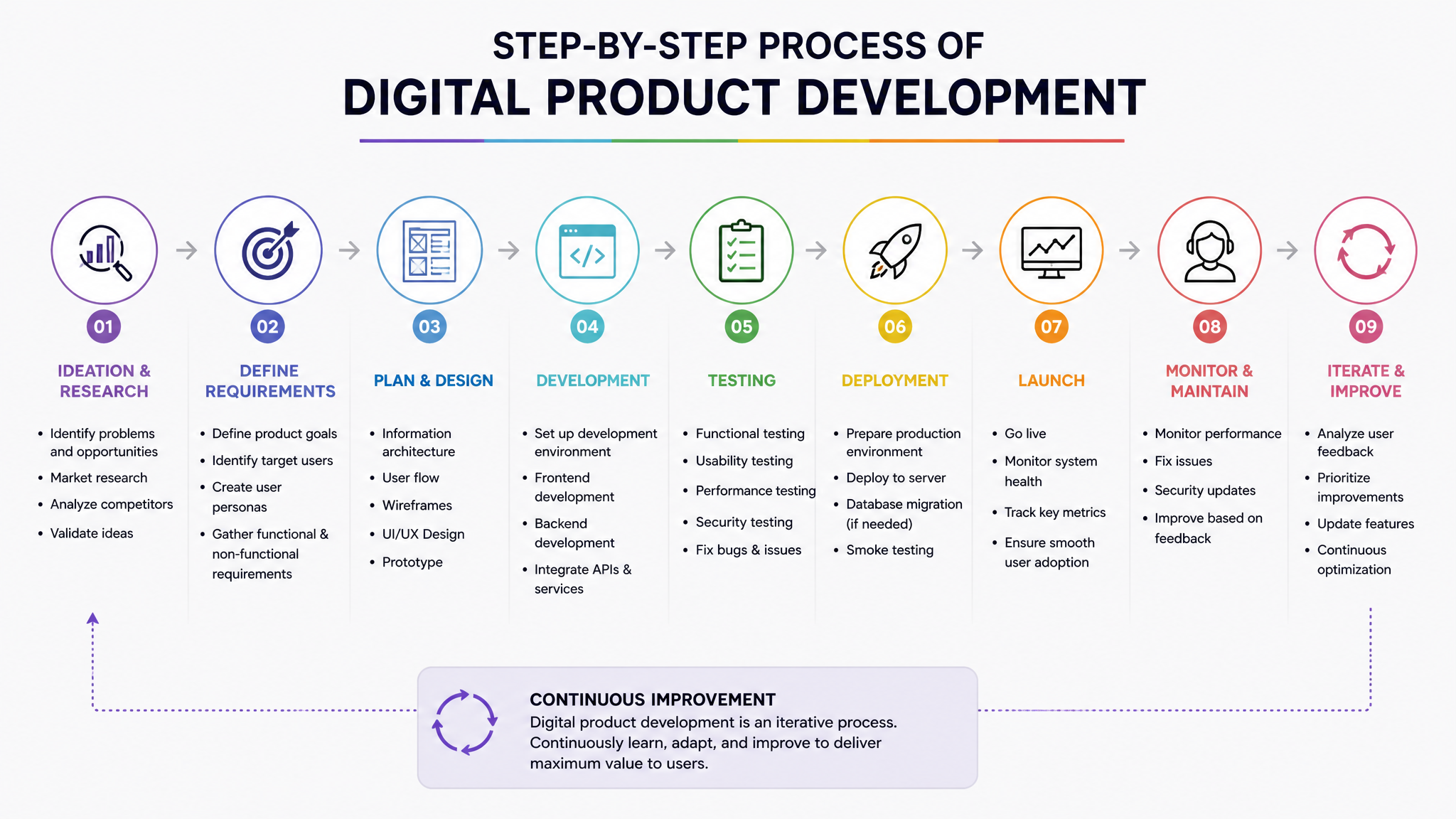
The Step-by-Step Process of Building a Digital Product
No two products follow an identical path, but the underlying stages are consistent. Here’s how a disciplined team moves from idea to a living product.
1. Discovery and problem framing.
Before anyone writes code, the team needs a sharp answer to who has the problem, how painful it is, and why existing options fall short. This is where good teams separate from average ones. Skipping discovery is the most expensive mistake in the field, because building the wrong thing well is still building the wrong thing.
2. Strategy and scope definition.
With the problem understood, you define the smallest version that proves the concept. This is your MVP, but the word “minimum” trips people up. The goal isn’t the cheapest build; it’s the smallest release that produces real learning. Scope here is a series of trade-offs: what ships now, what waits, and what gets deliberately cut.
3. Design and prototyping.
Interaction design, user flows, and clickable prototypes turn the strategy into something testable. Putting a prototype in front of five real users usually surfaces more insight than weeks of internal debate. Design decisions made here ripple through every later stage, so this is not the place to rush.
4. Engineering and architecture.
Now the build begins, and architecture choices made early determine how well the product scales later. Do you build a monolith that’s fast to start but harder to split, or microservices that cost more upfront but flex as you grow? There’s no universal answer. The right call depends on team size, expected scale, and how clearly you understand the domain.
5. Testing and quality assurance.
Automated tests, performance checks, and security reviews run continuously rather than as a final gate. The aim is to catch problems while they’re cheap to fix, not after they reach production.
6. Launch and deployment.
Modern launches rarely flip a single switch. Teams roll out to a small audience first, watch the metrics, and expand gradually. This limits blast radius when something breaks, because something always does eventually.
7. Measurement and iteration.
Once the product is live, usage data becomes the primary source of truth. Which features get used? Where do people drop off? What’s generating support tickets? Each answer feeds the next cycle of work. This stage never ends, and that’s the point.

Trends Shaping Digital Product Development in 2026-27
The fundamentals above are stable. What’s changing is the tooling and the economics around them.
AI-assisted engineering is becoming standard, not special.
Code generation, automated testing suggestions, and AI pair-programming tools are moving from novelty to baseline expectation. The productive teams aren’t the ones that adopt these tools fastest; they’re the ones that keep human judgment firmly in charge of architecture and product decisions while letting AI accelerate the mechanical work. Generated code still needs review, and AI confidently produces plausible-looking mistakes.
Composable and API-first architecture is winning.
Instead of building every capability in-house, teams assemble products from best-in-class services: authentication, payments, search, messaging. This shortens time to market but adds a new skill requirement: managing dependencies and integration points well. A product stitched together carelessly becomes fragile in ways a monolith never would.
Product and analytics are converging.
The gap between what a product team wants to know and what the data can tell them is narrowing. Event tracking, session analysis, and experimentation platforms are now accessible to teams that could never have afforded them a few years ago. The competitive edge is shifting toward how well a team interprets and acts on that data, not whether they collect it.
Edge delivery and performance expectations keep rising.
Users abandon slow experiences faster every year. Delivering content and compute closer to the user, rather than from one central location, is becoming a default consideration rather than an optimization you get to later.
The thread connecting these trends is compression. The time between idea and feedback keeps shrinking, which rewards teams built for continuous learning and punishes those still operating on annual release cycles.
What to Look for in a Digital Product Development Company
If you’re building a product and deciding whether to partner with an external team, the evaluation matters more than the price tag. A strong Digital Product Development Company does more than take requirements and return code. It pushes back on assumptions during discovery, flags trade-offs you hadn’t considered, and stays invested after launch when the real learning begins.
Here’s what separates a genuine partner from a staffing arrangement.
| What to evaluate | Weak signal | Strong signal |
|---|---|---|
| Discovery approach | Jumps straight to estimates | Invests in understanding the problem first |
| Scope conversations | Agrees to everything | Recommends what to cut and why |
| Architecture reasoning | One default stack for everything | Explains trade-offs for your specific case |
| Post-launch involvement | Hands off and disappears | Builds measurement and iteration into the plan |
| Communication | Status reports only | Raises risks early, proposes options |
A capable Digital Product Development Agency should be comfortable saying “that feature isn’t worth building yet” when the data doesn’t support it. Yes-teams feel easier to work with and cost you more in the long run, because you end up paying to build and then remove things that discovery would have caught.
Pay attention to how a potential partner talks about failure. Teams that have shipped real products can tell you about launches that underperformed and what they changed. Teams that only describe flawless outcomes are either lucky, inexperienced, or not being candid.
Why a Digital Product Development Company in india Can Be a Strong Fit
For many organizations balancing budget against capability, a Digital Product Development Company in india offers a practical combination of engineering depth, mature delivery practices, and cost efficiency. The country has a deep pool of product engineers, designers, and data specialists who have shipped products for global markets, which means the experience gap that once existed with offshore teams has largely closed for established firms.
That said, geography isn’t a quality guarantee on its own. The same evaluation criteria apply: how a partner handles discovery, how honestly they discuss trade-offs, and whether they stay engaged through iteration. Time-zone overlap, communication rhythm, and clarity around ownership matter just as much as hourly rates. The best outcomes come from treating an offshore partner as an extension of your team with shared goals, not as a vendor you hand a spec to and check on quarterly.
Logical Wings approaches digital product development as a continuous partnership rather than a fixed contract. That means starting with discovery, being honest about what to build and what to delay, making architecture decisions tied to your actual scale rather than a default template, and building measurement into the product so every release teaches you something. The goal is a product that keeps earning its place in your users’ workflows, not one that ships once and stalls.
Where This Leaves You
The evolution of digital product development comes down to a single shift: products are never finished, they’re iterated. The teams that thrive treat every release as a hypothesis, measure what happens, and let evidence guide the next move. The tooling will keep changing, AI will absorb more of the mechanical work, and feedback loops will keep tightening. What won’t change is the core discipline of understanding the problem deeply, shipping the smallest useful version, and learning relentlessly from real usage.
If you’re weighing whether to build in-house, hire a partner, or combine both, start by auditing your own feedback loop. How long does it take you to go from an idea to real user signal? That number tells you more about your readiness to build a successful digital product than any technology choice you’ll make.
Frequently Asked Questions
What is the difference between a digital product and a regular software project?
A software project has a defined scope and a completion date, while a digital product is an ongoing experience that gets measured and improved continuously after launch. The distinction matters because products require sustained investment in iteration, analytics, and refinement rather than a one-time build and handoff.
How long does it take to build a digital product?
A focused MVP designed to validate a single core problem can often reach users in a few months, but a full-featured product is never truly finished because it evolves with usage data and market feedback. The more honest question is how quickly you can get a testable version in front of real users to start learning.
Should I build my product in-house or hire a development partner?
It depends on whether product engineering is core to your competitive advantage and whether you have the talent to sustain it long term. Many organizations combine a small internal product team that owns strategy with an external partner that provides engineering depth and delivery experience.
How much does AI actually change the development process today?
AI meaningfully accelerates mechanical work like code generation, test writing, and documentation, which frees engineers to focus on architecture and product decisions. It does not replace human judgment because generated output still needs review and can introduce subtle errors that look correct at a glance.