Off-the-shelf software makes a promise: install it, configure it, and your problem is solved. For plenty of businesses, that promise holds. But when your workflow doesn’t fit the tool, or the tool forces your team to work around its limitations, you start paying a hidden tax in workarounds, spreadsheets, and manual data entry that nobody signed up for.
Custom software development is the alternative. It means building an application from the ground up to match how your business actually operates, rather than reshaping your operations to fit a product someone else designed for a general market. This article explains what that involves, when it makes sense, what it costs you in time and effort, and how to decide whether to build or buy.
What custom software development actually means
At its core, custom software is any application designed and built for a specific organization or use case, rather than sold as a packaged product to many customers. Think of an internal logistics platform that tracks a courier company’s exact routing rules, or a patient intake system built around one clinic’s referral process.
The difference from commercial software isn’t just personalization. A CRM that lets you rename fields or add a custom tab is still a fixed product with defined boundaries. Custom software has no such ceiling. The data model, the business logic, the integrations, and the user experience are all decisions you make, not constraints you inherit.
That freedom comes with responsibility. You own the roadmap, and you own the maintenance. There’s no vendor releasing quarterly updates for you, which is both the appeal and the commitment.
The problems custom development is built to solve
Most businesses don’t wake up wanting custom software. They arrive at it after hitting a wall. A few common walls:
-
- Process mismatch. Your operation depends on a workflow that no commercial tool models correctly, so your team maintains a growing tangle of spreadsheets and manual steps to bridge the gap between what the software does and what the business needs.
- Integration debt. You run six different tools that don’t talk to each other, and staff spend hours copying data between them, introducing errors and delays that compound as you scale.
- Licensing that punishes growth. Per-seat or per-transaction pricing on a SaaS product becomes painful once you reach a certain size, and the math starts favoring an asset you own outright over a subscription that never stops climbing.
- Competitive differentiation. Your process is your advantage, and handing it to a tool every competitor also uses erases the edge you spent years building.
If none of these describe you, off-the-shelf is probably the smarter call. Custom software earns its cost when the gap between what you need and what you can buy is wide enough to hurt.
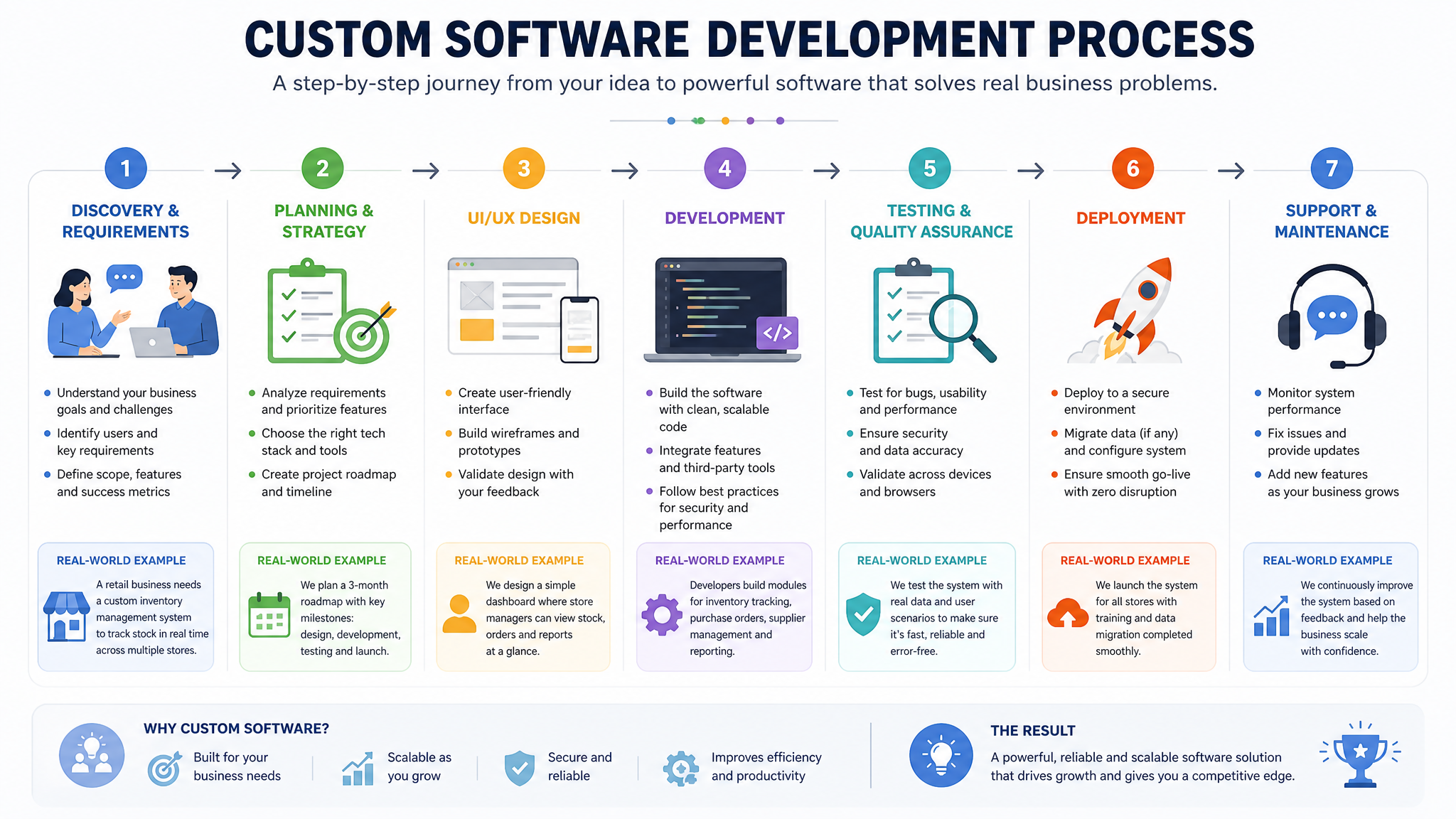
How a custom software project typically unfolds
There’s no single correct process, but most serious builds move through recognizable phases. Understanding them helps you spot a competent partner from one that’s improvising.
Discovery and requirements.
Before any code, a good team digs into how your business works, who the users are, and what “done” looks like. Skimping here is the most reliable way to build the wrong thing well.
Architecture and planning.
Decisions get made about the technology stack, how the system will scale, where data lives, and how the pieces connect. These early choices are expensive to reverse later, so they deserve real attention.
Design and prototyping.
Wireframes and interactive prototypes let you see and test the flow before development locks it in. Catching a confusing workflow at this stage costs a conversation. Catching it after launch costs a rebuild.
Development.
Work usually proceeds in iterations, delivering functional pieces you can review rather than disappearing for months and returning with a finished black box.
Testing and quality assurance.
Beyond checking that features work, this covers edge cases, security, performance under load, and how the system behaves when users do something unexpected.
Deployment and maintenance.
Launch is the beginning, not the end. Software needs monitoring, security patches, and updates as your business and its dependencies evolve.
Why a custom software development company in india appeals to global businesses
Cost is the obvious draw, but it’s rarely the whole story. Hiring a custom software development company in india gives businesses in North America, Europe, and Australia access to a large, English-proficient engineering talent pool at rates that stretch a budget further, without the overhead of building an in-house team from scratch.
The deeper value tends to show up in delivery models. Established firms have refined the practice of working across time zones, running structured handoffs, and managing distributed collaboration in ways that many local shops never had to master. For a startup that needs to move from concept to a working product without burning its runway on salaries, this can be the difference between shipping and stalling.
That said, geography alone guarantees nothing. Quality varies enormously within any market. What matters is the specific team’s track record, communication discipline, and whether they treat your problem as their own. A cheap rate attached to poor requirements gathering produces expensive rework, which erases any savings you thought you were getting.

Build versus buy: a framework for deciding
Rather than a gut call, run your situation through a few honest questions. The table below frames the trade-off along the dimensions that usually decide it.
| Factor | Lean toward buying | Lean toward building custom |
|---|---|---|
| Process uniqueness | Your workflow is standard for your industry | Your process is unusual or a core differentiator |
| Time pressure | You need something running this month | You can invest weeks or months upfront |
| Budget shape | Limited upfront capital, comfortable with subscriptions | Capital available to invest, want to own the asset |
| Integration needs | Few integrations, or the tool covers them | Complex, tool-spanning workflows |
| Control requirements | Vendor-defined roadmap is acceptable | You need full control over features and data |
| Scale economics | Small, stable user base | Growth makes per-seat licensing painful |
Most real decisions land somewhere in the middle, and a hybrid answer is often the right one. You might buy proven components like payment processing or email delivery and build custom only the parts that define your competitive edge. Reinventing a solved problem rarely pays off.
What custom software realistically costs
The honest answer is that it depends, but a few drivers matter more than the rest:
-
- Scope and complexity.
A single-purpose internal tool sits at one end of the spectrum, while a multi-user platform with real-time features, integrations, and strict compliance requirements sits at the other, and the gap between them is enormous. - Team composition and rates.
Where and by whom the work gets done shapes the number significantly, which is a large part of why so many companies look offshore. - Ongoing maintenance.
Budget for the life of the software, not just the build. Hosting, updates, security, and support are recurring realities, not optional extras.
- Scope and complexity.
Be wary of any quote that arrives before a serious conversation about your requirements. A precise estimate for vaguely defined work is a red flag, not reassurance. Good partners give ranges early and tighten them as the picture sharpens.
When a custom software development agency is the right fit
Not every organization needs a full agency. If you have strong internal engineering leadership and just need extra hands, staff augmentation might serve you better. But a custom software development agency earns its place when you need a complete team that owns delivery end to end, from strategy and design through development and support, without you having to assemble and manage each specialist yourself.
This matters most for companies without deep technical bench strength in-house. A founder with a clear product vision but no engineering background, or an operations leader who understands the business problem but not how to build the solution, benefits from a partner that fills the entire gap. The agency brings not just coders but architects, designers, project managers, and QA, which are roles that individually would take months to hire and coordinate.
The trade-off is dependency. You’re trusting an external group with something central to your business, so the relationship’s quality, transparency, and responsiveness matter as much as raw technical skill. This is where a firm like Logical Wings focuses its work, pairing engineering capability with the communication discipline that keeps distributed projects on track.
Common mistakes that derail custom builds
Even well-funded projects go sideways, and the reasons repeat:
- Vague requirements. “Build us a platform like X but for our industry” is not a specification, and starting development on a fuzzy brief is the surest way to overshoot budget and timeline while missing the actual need.
- Skipping the prototype. Committing to full development before validating the workflow with users means you discover design problems at the most expensive possible moment, after everything is already built.
- Ignoring maintenance from day one. Teams that plan only for the build and treat support as an afterthought end up with software that decays quietly until something breaks in production.
- Choosing on price alone. The lowest bid frequently becomes the most expensive project once rework, missed requirements, and communication breakdowns pile up over the course of delivery.
The thread running through all of these is the same: successful custom software is a partnership, not a transaction. The teams that treat it that way get software that fits. The ones that don’t get an expensive lesson.