Your Website Is Not Your Problem. Your web development partner might be.
A marketing head at a mid-sized manufacturing firm spent ₹12 lakhs on a website redesign. New visuals. Faster load time. Mobile-optimised. Launched in October. By March, organic traffic had dropped 34%. The development firm had rebuilt the site on a new URL structure without redirects, orphaned 200+ indexed pages, and handed over a technically clean product that Google had effectively stopped trusting.
For businesses in Gujarat and across India evaluating their next web investment, working with a web development company in Ahmedabad that combines technical depth with genuine digital marketing capability produces a fundamentally different outcome than separating the two. The developer did exactly what was contracted. Nobody in the engagement owned SEO. Nobody asked.
This is the version of web development failure that doesn’t show up in case studies: the one where the product works but the business outcome doesn’t. It’s more common than executives realise, and it’s almost entirely preventable when the right questions get asked before the contract is signed.
If you’re a business owner, CTO, or marketing head evaluating a web development partner right now, this article covers what you actually need to know — what web development is and isn’t, why it matters commercially, what full-service agencies should offer, how to pick the right technology, and the questions that separate credible partners from expensive disappointments.
What Is Web Development?
Web development is the technical discipline of building and maintaining websites and web applications, the code, architecture, databases, and infrastructure that make digital properties function. It is not design. Design determines how something looks. Development determines how it works, how fast it loads, how it handles data, how it integrates with other systems, and how well it performs under real traffic conditions.
Web development covers three layers:
- Frontend development — everything a user sees and interacts with: interface components, navigation, forms, animations, and responsive behaviour across devices.
- Backend development — the server-side logic, databases, APIs, and business rules that process data and power application functionality.
- Full-stack development — both layers, often with additional responsibility for deployment infrastructure and third-party integrations
For businesses, web development is not an IT function; it is a revenue function. The performance of a web property directly affects how many leads convert, how long users stay, whether search engines surface the content, and whether the operational systems behind the site can support business growth.
Why Web Development Matters More Than Most Businesses Treat It
Here is the honest version of this conversation: most businesses treat their website like a brochure and their web development like a print job. Brief the vendor, approve the design, publish it, move on. That mental model explains a significant portion of why business websites underperform.
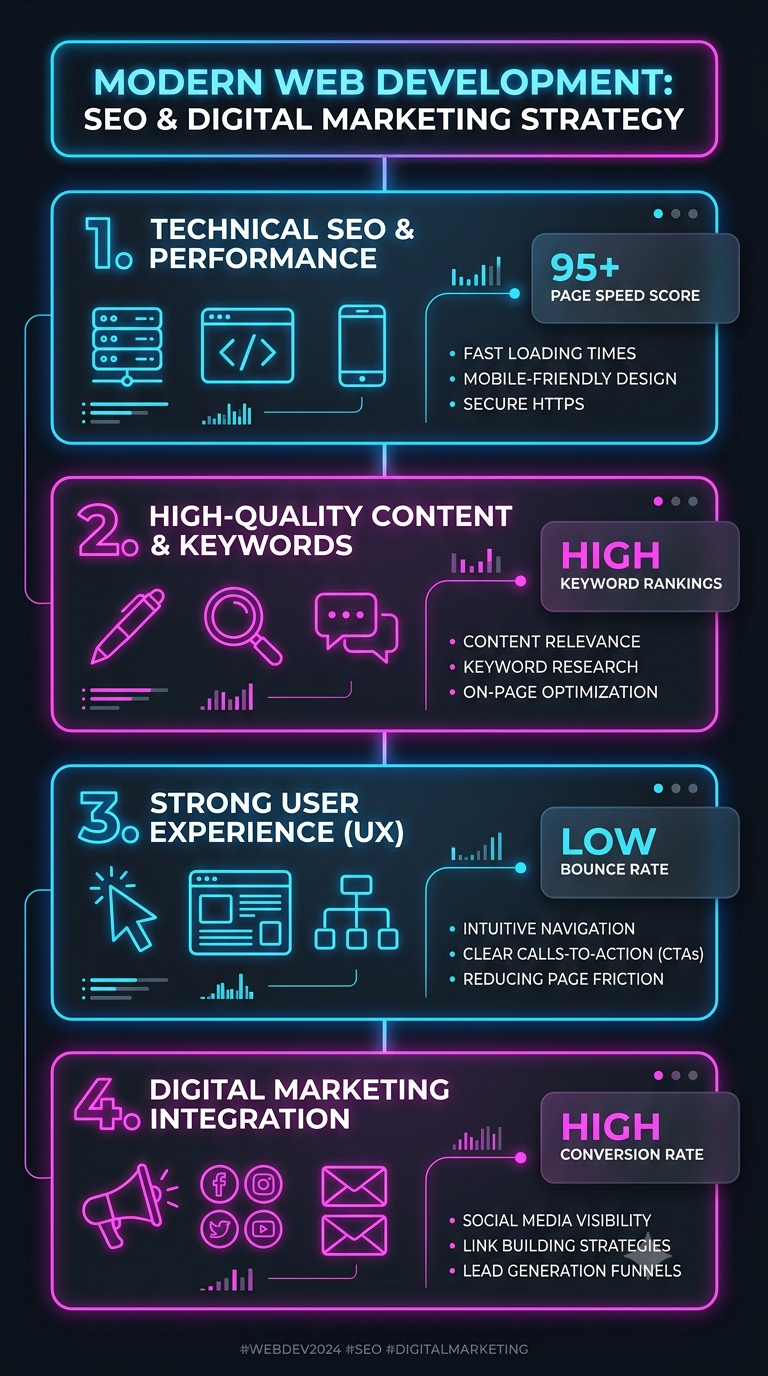
What a commercial-grade web presence actually affects:
- Search visibility:
Site architecture, page speed, Core Web Vitals, structured data, and crawlability are technical factors that determine whether Google surfaces a business in relevant searches. These are development decisions, not content decisions. - Conversion rate:
How the site is built determines how fast it loads, how friction-free the user journey is, and whether calls to action are technically functional. A beautifully designed site built on slow infrastructure converts at a fraction of its potential. - Operational integration:
Whether the website connects to the CRM, the analytics platform, the marketing automation tool, and the inventory system determines whether the business can act on the leads and behaviour data the site generates. - Scalability:
A site built on architecture that can’t handle traffic spikes or content growth forces expensive rebuilds exactly when business momentum should be accelerating.
The businesses that get consistent commercial value from their web presence treat development as a strategic investment not a one-time expense.
Key Services Offered by Full-Service Web Agencies
A full-service agency covers the complete stack from strategy through post-launch performance. Here’s what that scope looks like and what each component delivers:
| Service | What It Delivers |
| Web Strategy & Architecture | Sitemap design, URL structure, technical SEO foundation, CMS selection |
| UX/UI Design | User journey mapping, wireframes, prototypes, responsive design |
| Frontend Development | React/Vue/Angular interfaces, performance optimization, accessibility compliance |
| Backend Development | Custom APIs, database architecture, business logic, admin systems |
| CMS Implementation | WordPress, Webflow, Contentful, or headless CMS setup and configuration |
| E-commerce Development | Shopify, WooCommerce, or custom commerce platform builds |
| SEO Integration | Technical SEO audit, on-page implementation, schema markup, Core Web Vitals optimization |
| Analytics & Tracking | GA4 setup, conversion tracking, heatmap integration, tag management |
| Digital Marketing Services | Paid media management, content strategy, email automation, social integration |
| Maintenance & Support | Security updates, performance monitoring, content updates, uptime management |
When reviewing proposals, map every item in this table to a named owner in the engagement. Services without a clear owner become nobody’s responsibility after launch.
How to Choose the Right Technology Stack for Web Development
Technology decisions made at project start create constraints that last for years. These criteria matter more than whatever framework is trending at the moment.
Match the stack to the business requirement, not the developer’s preference. A CMS-driven marketing site, a custom SaaS application, and a high-volume e-commerce platform have fundamentally different technical requirements. The right stack for one is wrong for another.
Evaluate the content management requirement honestly. If non-technical team members need to update the site regularly, the CMS must be genuinely usable by non-developers — not just technically capable of being managed by them. WordPress, Webflow, and Contentful serve different operator profiles.
Factor in the integration landscape before committing. If the site must connect to a CRM, marketing automation platform, ERP, or payment provider, verify that the chosen stack has mature, maintained connectors for those systems. Integration problems discovered mid-build are expensive.
Common stack decisions by use case:
| Business Requirement | Recommended Stack | Why |
| Marketing website with frequent content updates | Webflow or WordPress + Headless | Non-technical content management, fast page performance |
| SaaS product or web application | React/Next.js + Node.js or Python backend | Component architecture, API-first, scalable |
| E-commerce (mid-market) | Shopify Plus or WooCommerce + custom theme | Proven commerce infrastructure, extensive plugin ecosystem |
| Enterprise portal or internal tool | Angular + Java/Spring or .NET backend | Typed codebase, enterprise integration support |
| High-performance content platform | Next.js + Contentful/Sanio (headless) | Static generation, CDN delivery, editorial flexibility |
How to Choose the Right Web Development Company for a Startup
Startups face a specific version of this decision that established businesses don’t: limited budget, high stakes, and no internal technical capacity to evaluate what they’re buying.
Prioritise domain experience over portfolio aesthetics.
A firm that has built three products in your category has already solved your specific integration problems, knows your compliance requirements, and has made the architecture mistakes that derail first-time builds. A beautiful portfolio of unrelated work tells you less than one relevant case study with a reference you can call.
Insist on a discovery phase before any build commitment.
The first engagement should be paid discovery, defining the problem, mapping the user, and scoping the MVP. Any firm that wants to skip discovery and start building is prioritising their billing cycle over your outcome.
Understand the team structure you’re actually getting.
Some agencies pitch senior talent and staff projects with junior developers under minimal oversight. Ask specifically: Who will write the code? What is their experience level, and how many projects will they be managing simultaneously alongside yours?
Verify post-launch support terms before signing.
The first 60 days after launch almost always surface issues, performance bottlenecks, integration failures, and edge cases the testing environment didn’t catch. Know exactly what support is included, at what response time, and what it costs beyond the included scope.
For startups specifically, watch for these red flags:
- No fixed milestone structure (means no accountability checkpoints)
- Hourly billing only with no scope definition (means unlimited cost exposure)
- Inability to provide a direct client reference in a similar business category
- Vague answers about who owns the code and hosting infrastructure after delivery
Conclusion: The Website That Performs Is the Website That Was Built Right
A web presence that drives business outcomes, qualified leads, organic search visibility, and operational efficiency is not primarily a design achievement. It is a development achievement. The architecture decisions, the technology choices, the SEO integration, the integration with CRM and analytics, and the post-launch monitoring – these determine commercial performance more than any visual element does.
And choosing a web development company in India with full-service web capability, strategy, design, engineering, SEO, and post-launch support under one roof eliminates the accountability gaps that make most web investments underperform.
The right partner will challenge your brief, ask uncomfortable questions about what you’re trying to achieve commercially, and take responsibility for outcomes — not just delivery.
If your current web presence isn’t generating the results the business needs, let’s have an honest conversation about why and what a properly built alternative would actually look like.