

Cross-platform mobile app development has never been more strategically critical or more hotly debated. When you’re deciding where to invest development budget, the Flutter vs React Native decision isn’t just a technical one. It shapes hiring, timelines, costs, and the long-term maintainability of your product
What Is Flutter?
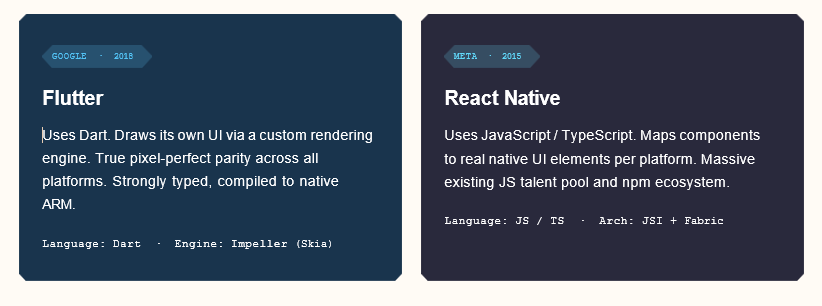
Flutter is Google’s open-source UI toolkit for building natively compiled applications from a single codebase targeting mobile, web, desktop, and embedded devices. Launched in 2018, it uses Dart, a compiled, strongly-typed language that Google developed in-house.
Flutter’s core architectural innovation is its own rendering engine (Skia, now transitioning to Impeller). Rather than relying on platform native components, Flutter draws every pixel itself. This gives Flutter app developers pixel-perfect consistency across iOS, Android, web, and desktop — at the cost of slightly larger app bundles.
What Is React Native?
React Native was born inside Facebook (now Meta) in 2015 and open-sourced to wide adoption. It lets React Native developers use JavaScript or TypeScript — languages familiar to the vast majority of front-end engineers to build mobile apps that bridge to actual native components on each platform.
Its 2022 architectural rewrite introduced the New Architecture (JSI, Fabric, TurboModules), dramatically reducing the JavaScript-to-native bridge overhead that once held it back. In 2026, this new architecture is stable and widely adopted.
Features & Advantages of React Native
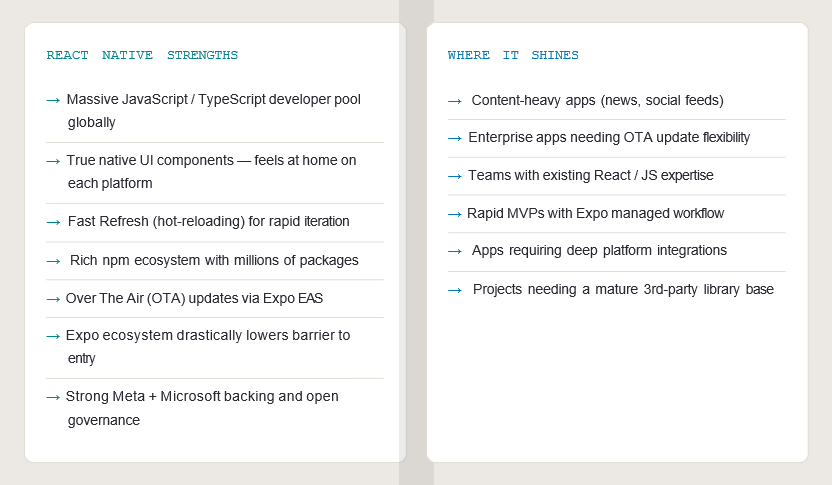
For teams already invested in the JavaScript ecosystem, React Native remains a compelling choice for mobile app development:
Developing Cross-Platform Apps with React Native
The recommended path in 2026 is Expo a managed workflow that abstracts away build complexity. npx create-expo-app bootstraps a project in minutes. Expo Go enables instant device previews without needing Xcode or Android Studio for most development tasks. Expo EAS handles CI/CD and OTA updates. For bare workflow needs, react-native-cli gives full control. Debugging is handled via React DevTools, Flipper, or the built-in Metro bundler console.
Features & Advantages of Flutter
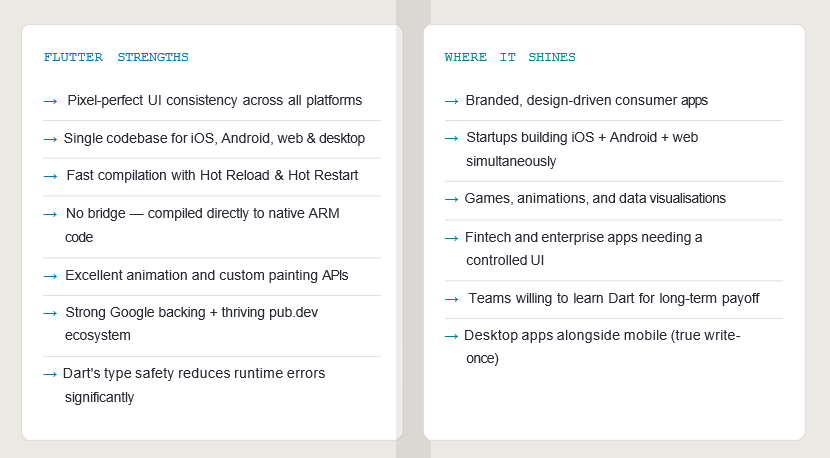
Flutter’s proposition is increasingly attractive for product companies and IT service providers building long-lasting, visually rich applications:
React Native vs. Flutter: Head-to-Head Comparison
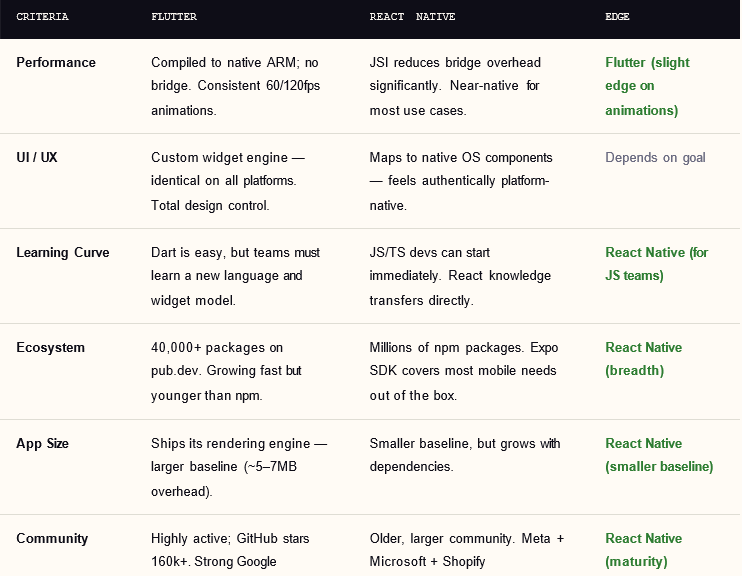
Here’s how both frameworks stack up across the dimensions that matter most to businesses and IT teams:
React Native vs. Flutter: Roadmaps & Future Plans
Both frameworks are in active development with ambitious roadmaps heading into 2026 and beyond:
Flutter: Impeller Engine GA + Web Performance
Flutter’s new Impeller rendering engine is now the default on iOS and Android, eliminating shader compilation jank. Web performance is a major focus for 2025–26, with CanvasKit and HTML renderer convergence.
Flutter: Dart 3.x & WASM Support
Dart 3’s records, patterns, and class modifiers improve developer ergonomics. WebAssembly (WASM) compilation is unlocking Flutter for high-performance web apps — a major inflection point.
React Native: New Architecture (Default)
As of 2024–25, the New Architecture (Fabric + TurboModules + JSI) is stable and the default for new projects, resolving the legacy bridge performance criticism. The ecosystem is catching up rapidly.
React Native: Server Components & Expo Router
React Server Components are being adapted for mobile, and Expo Router (file-based navigation) is maturing into the standard architecture — bringing web-like DX to mobile app development.
Both: AI-Assisted Development Tooling
AI code generation (GitHub Copilot, Claude, Gemini) is fluent in both Dart and TypeScript/JSX. Neither framework has a meaningful AI tooling advantage — both benefit equally from the LLM wave.
Which One Will Be Better in 2026?
There is no universal winner — and anyone claiming otherwise is selling something. The more useful answer is which framework is better for your specific situation:
Choose Flutter if
You’re building a highly branded consumer app where design consistency is paramount. You want to ship iOS, Android, and web from a single team without painful CSS workarounds. You’re a startup building a long-term product and can afford the short-term Dart onboarding. You care about performance in complex animations, fintech UIs, or data visualisations. Flutter’s growth trajectory — now the most used cross-platform framework globally per Stack Overflow surveys — signals long-term commitment from Google.
Choose React Native if
Your team has JavaScript / React expertise and you need to move fast. You’re an IT service provider staffing projects and need a large available talent pool to draw from. You need deep OTA update capability for enterprise apps. You’re building an app that leans heavily on native platform behaviour (Camera, Bluetooth, AR) and existing JS libraries. The Expo ecosystem in 2026 makes React Native’s developer experience genuinely excellent for most business apps
Conclusion
Both Flutter and React Native are mature, production-grade solutions for cross-platform mobile app development in 2026. The “war” between them is largely settled into a healthy coexistence, each with a clear niche.
For mobile app startups prioritising speed-to-market with an existing JS team: React Native (especially Expo) is hard to beat. For product companies and IT service providers building differentiated, visually rich, multi-platform experiences: Flutter’s unified rendering and Dart’s type safety offer meaningful long-term advantages.
The smartest move is not to let the framework choose the product — it’s to choose the framework that aligns with your team’s strengths, your customers’ expectations, and your 3-year product roadmap.
When in doubt, consult with experienced developers who have shipped production apps on both — and let your specific requirements drive the decision.
Frequently Asked Questions
) Is Flutter or React Native better for beginners?
React Native has the lower barrier to entry for developers who already know JavaScript or React — which describes most front-end developers today. Flutter requires learning Dart, but Dart is arguably simpler and more consistent than JavaScript. For non-JS developers starting fresh, Flutter’s documentation and structured widget model can actually make it easier to learn. For absolute beginners with no prior coding experience, either framework is approachable via tutorials; React Native has more beginner content given its larger community.
) Which framework is better for performance-intensive apps?
Flutter holds a slight edge for graphics-heavy, animation-rich, or real-time UI applications because it compiles to native ARM code and renders through its own engine (Impeller), bypassing any JS bridge entirely. React Native’s New Architecture has closed much of this gap for typical business apps. For most CRUD-style enterprise or e-commerce apps, performance is not a differentiator — both are more than fast enough. For games, real-time data dashboards, or complex animation, Flutter is the stronger choice.
) Can I use React Native for complex enterprise apps?
Absolutely. React Native powers enterprise applications at scale — Microsoft Office Mobile, Shopify, and Coinbase are notable examples. With the New Architecture stabilised, TypeScript enforcement, and Expo’s managed CI/CD pipeline, React Native is a legitimate enterprise-grade choice. Its OTA update capability via Expo EAS is actually a unique advantage for enterprise apps requiring rapid patch deployments without full App Store review cycles.
)What are the main differences in UI development between Flutter and React Native?
)How does community support differ for Flutter and React Native?
React Native has a larger, older community with more Stack Overflow answers, blog posts, and third-party libraries owing to its 2015 launch. It also benefits from Meta, Microsoft, and Shopify as major open-source contributors.
Flutter’s community, while younger, has grown explosively — it’s consistently among the top frameworks in GitHub star counts and developer satisfaction surveys. Flutter’s official documentation is widely praised as more comprehensive and better structured. For hiring, React Native developers are more abundant globally; Flutter app developers are in high and growing demand with slightly less supply, which can affect contractor rates.