Key Takeaways
- Mobile app development covers the full process of designing, building, testing, and maintaining software for Android and iOS devices.
- Choosing a local partner in Ahmedabad gives you closer collaboration, timezone overlap for teams across regions, and cost efficiency without cutting quality.
- Native, cross-platform, and hybrid approaches each suit different budgets and product goals, so the right choice depends on your users and roadmap.
- A well-built app can widen your reach, strengthen customer loyalty, and open direct revenue channels that a website alone struggles to match.
- Logical Wings works as an end-to-end Android and iOS development partner, from early strategy through post-launch support.
Most businesses don’t need a mobile app because it’s trendy. They need one because their customers already live on their phones, and a clunky mobile experience quietly loses them sales. If you’re evaluating a mobile app development company in Ahmedabad to build Android and iOS apps, the real question isn’t whether you need an app. It’s whether your development partner understands your users well enough to build something they’ll actually keep.
This guide walks through what mobile app development involves, the service models available, the business case for building an app, and what to weigh when picking a partner in Ahmedabad.
What Mobile App Development Actually Involves
At its core, mobile app development is the process of creating software that runs on smartphones and tablets. But that one-line definition hides a lot of moving parts.
A real project moves through discovery, design, development, testing, deployment, and ongoing maintenance. Discovery is where you define who the app is for and what problem it solves. Design turns that into wireframes and interfaces people can navigate without a manual. Development is the actual engineering, splitting into the front-end that users tap through and the back-end that handles data, authentication, and business logic.
Testing deserves more attention than it usually gets. An app that works on the developer’s phone can break on a two-year-old Android device with limited memory or an older iOS version. Good teams test across a range of devices, screen sizes, and network conditions before anything reaches an app store.
Then there’s the part many first-time app owners underestimate: maintenance. Operating systems update, devices change, and security patches never stop. An app is a living product, not a one-time build.
Why a Mobile App Development Company Matters for Your Project
You could hire app developers piece by piece, but coordinating a designer, two developers, a QA tester, and a backend engineer yourself rarely ends well. Handoffs slip, accountability blurs, and you become the project manager for a discipline you don’t fully understand.
A dedicated mobile app development company brings those roles under one roof with shared processes. That means a designer who talks to the developer daily, a tester embedded from the start rather than bolted on at the end, and one point of accountability when something breaks.
The other advantage is judgment. Experienced teams have shipped enough apps to spot problems early. They’ll tell you when a feature you’re excited about will confuse users, or when a shortcut will cost you three times more to fix after launch. That kind of pushback is worth more than blind agreement.
For a mobile app development company for startups, this matters even more. Startups run on limited runway and can’t afford to rebuild an app six months in because the architecture didn’t scale. A partner who thinks about growth from day one saves both money and momentum.
Types of Mobile App Development Services
Not every app should be built the same way. The right approach depends on your audience, budget, and how much performance your product demands.
| Approach | Best For | Trade-offs |
|---|---|---|
| Native (separate Android and iOS builds) | Apps needing top performance, heavy device features, or gaming | Higher cost and longer timeline since you maintain two codebases |
| Cross-platform (one codebase, both platforms) | Startups and businesses wanting speed and cost efficiency | Slight performance ceiling for very complex, hardware-heavy apps |
| Hybrid / web-based | Simple content apps or early MVPs on a tight budget | Weaker native feel and limited access to advanced device features |
Native development means building an Android app in Kotlin or Java and a separate iOS app in Swift. You get the smoothest performance and full access to device hardware, but you’re maintaining two products. This suits apps where responsiveness is non-negotiable.
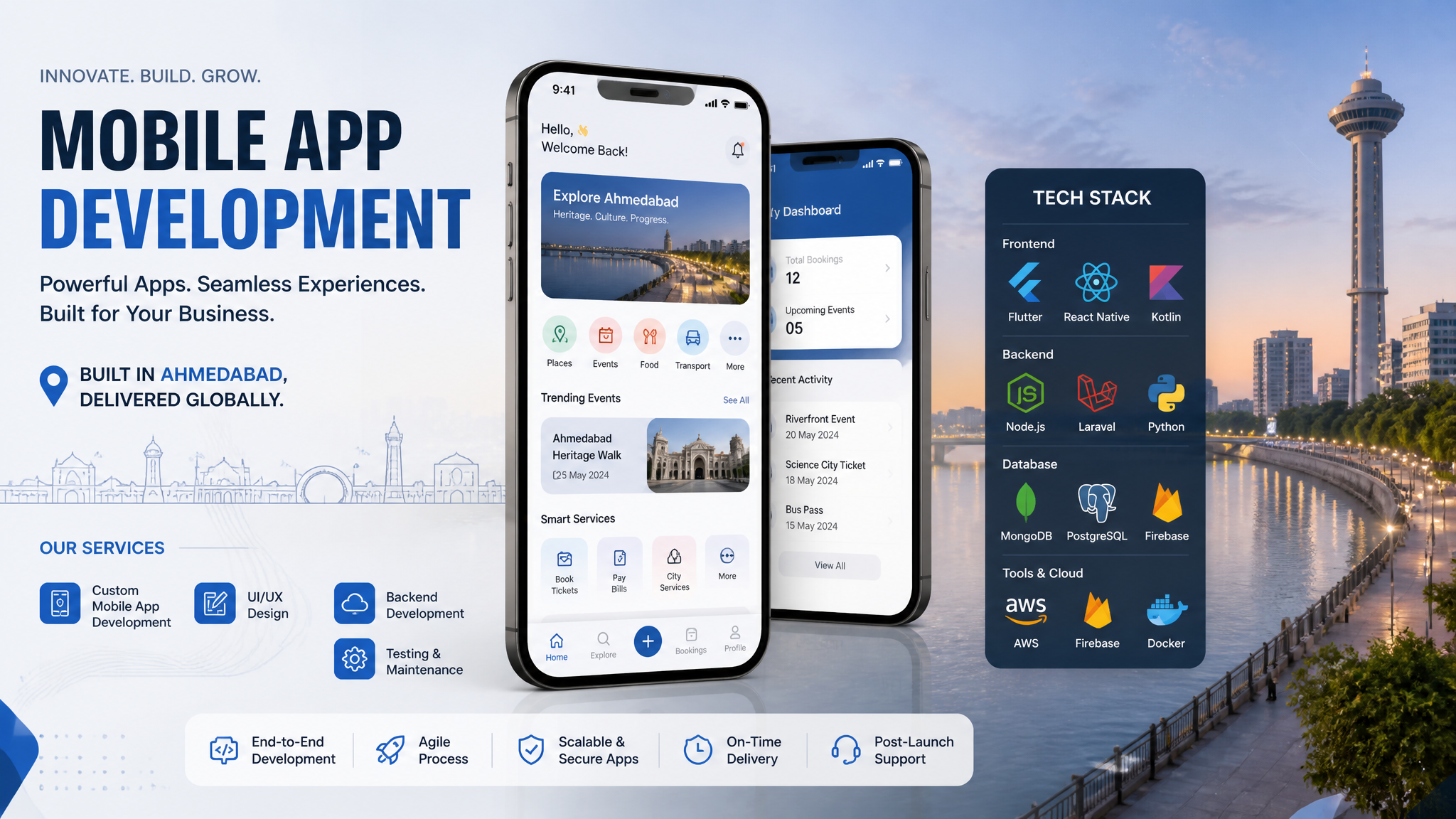
Cross-platform frameworks like Flutter and React Native let a single codebase serve both platforms. For most business apps, the difference in user experience is negligible, and the cost savings are real. This is often the practical choice for teams that want to reach Android and iOS users quickly.
Beyond the build approach, a full-service partner typically also handles UI/UX design, API and backend development, third-party integrations, app store submission, and post-launch support. Ask a prospective partner which of these they cover in-house versus outsource, because gaps there tend to surface at the worst moments.

The Business Case for Building a Mobile App
A mobile app isn’t just a smaller version of your website. It changes how customers interact with you and what you can offer them.
The most immediate benefit is presence. An icon on someone’s home screen is a standing reminder your business exists, something a browser bookmark never delivers. That constant visibility compounds over time.
Push notifications are the second lever. Used well, they bring people back with relevant, timely messages rather than hoping they remember to visit. Used badly, they annoy people into uninstalling, so restraint matters. A retail app might notify a customer when an item they viewed drops in price. A service app might remind someone about an upcoming appointment.
Apps also unlock capabilities websites handle poorly: offline access, camera and GPS integration, biometric login, and faster performance because assets live on the device. Consider a field-service business whose technicians need to log job details in areas with spotty signal. A mobile app can store that data locally and sync once a connection returns, something a web page simply can’t do reliably.
There’s a loyalty angle too. Customers who install your app tend to engage more often and spend more over time, partly because the friction of returning is so much lower. And for many businesses, the app itself becomes a revenue channel through in-app purchases, subscriptions, or streamlined checkout.
None of this is automatic. An app that duplicates your website without adding value will sit unused. The business case holds only when the app does something meaningfully better than the alternatives your customers already have.
Why a Mobile App Development Company in Ahmedabad in Is the Right Fit
Ahmedabad has grown into a serious hub for software and mobile development, and that maturity works in your favour whether you’re based nearby or overseas.
Cost is the obvious draw. Development rates here are considerably lower than in North America, Western Europe, or Australia, without the quality gap people sometimes assume. Many teams in the city have delivered apps for clients across the globe and follow the same engineering standards as agencies charging several times more.
For local businesses, proximity means face-to-face collaboration, easier trust-building, and a partner who understands the regional market. For international clients, the timezone often overlaps enough with a morning or evening call, and the talent pool is deep. Choosing an Android and iOS app development company in Ahmedabad gives you access to engineers experienced across both platforms rather than specialists who only handle one.
The city’s ecosystem also matters. A concentration of tech talent means teams stay current with frameworks, design trends, and store guidelines, because the competition keeps everyone sharp. That’s harder to guarantee from an isolated freelancer or a firm in a market with less mobile focus.
Why Logical Wings Is a Strong Choice in Ahmedabad
Plenty of agencies can write code. The difference shows up in how they think about your product and what happens after launch.
Logical Wings approaches mobile app development as an end-to-end partnership rather than a coding assignment. That means engaging early on strategy, questioning assumptions, and building an architecture that can grow rather than one that just ships the first version. For founders and business owners, that early clarity often prevents the expensive rebuilds that sink first-time app projects.
The team works across native and cross-platform development for both Android and iOS, so the recommendation you get is based on your actual needs rather than the only skill set available. Design, development, testing, and post-launch support sit under one roof, which keeps accountability clear and handoffs clean.
For startups especially, the value is a partner who understands limited runway and builds accordingly, prioritising the features that prove your idea and deferring the ones that can wait. And because support continues after launch, you’re not left scrambling when an OS update or a new device breaks something months down the line.
If you’re weighing options, the practical next step is a conversation about your product goals before any code gets written. The right partner should be able to tell you not just how they’d build your app, but whether the version you’re imagining is the one your users actually need.
Frequently Asked Questions
How long does it take to build a mobile app?
A straightforward app with a focused feature set often takes a few months from discovery to launch, while complex apps with custom backends, integrations, and native features can run considerably longer. The honest answer depends on scope, so a good partner will give you a timeline only after understanding what you actually need.
Should I build for Android or iOS first?
It depends on where your users are. If you’re targeting a market or audience that skews heavily toward one platform, start there. If you want both from launch without doubling cost, a cross-platform build lets you reach Android and iOS users from a single codebase.
What does app maintenance actually involve after launch?
Maintenance covers compatibility updates for new OS versions and devices, security patches, bug fixes, performance tuning, and often small feature improvements based on user feedback. Treating it as an ongoing budget line rather than an afterthought keeps your app usable and secure over time.
Is a cross-platform app good enough for a serious product?
For most business apps, yes. Modern cross-platform frameworks deliver performance and user experience close enough to native that users rarely notice a difference. Native still makes sense for graphics-heavy apps, games, or products that lean hard on device hardware.