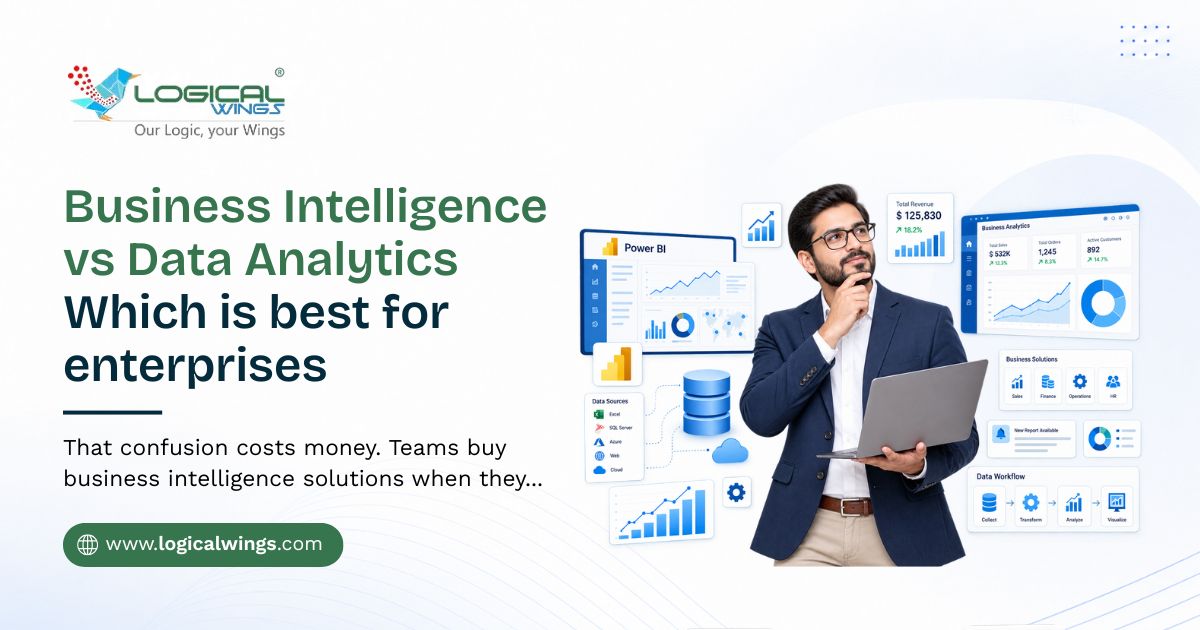
Here’s a stat that should stop you mid-scroll: companies using data-driven decision-making are 23 times more likely to acquire customers and 6 times more likely to retain them, according to McKinsey research. Yet most executives still can’t clearly explain the difference between business intelligence and data analytics, let alone tell you which one their company actually needs right now.
That confusion costs money. Teams buy business intelligence solutions when they need predictive modeling. Others hire analysts when a simple dashboard would solve the problem. This post breaks down both disciplines in plain terms, shows you what each one delivers, and helps you figure out where to put your next budget dollar.
By the end, you’ll know exactly what business intelligence solutions bring to your operations, what data analytics services India providers offer that local vendors often can’t match, and how to evaluate any partner you’re considering.
Business Intelligence vs. Business Data Analytics: Which One Does Your Business Need?
Every business generates data—from sales and customer interactions to inventory, finance, marketing, and employee performance. The real challenge isn’t collecting data; it’s turning that data into smarter business decisions.
Many business owners and decision-makers often hear the terms Business Intelligence (BI) and Business Data Analytics (BDA) used interchangeably. While both help organizations make data-driven decisions, they serve different purposes and deliver different business outcomes.
Understanding the difference between Business Intelligence and Business Data Analytics can help you invest in the right technology, improve operational efficiency, and gain a competitive advantage.
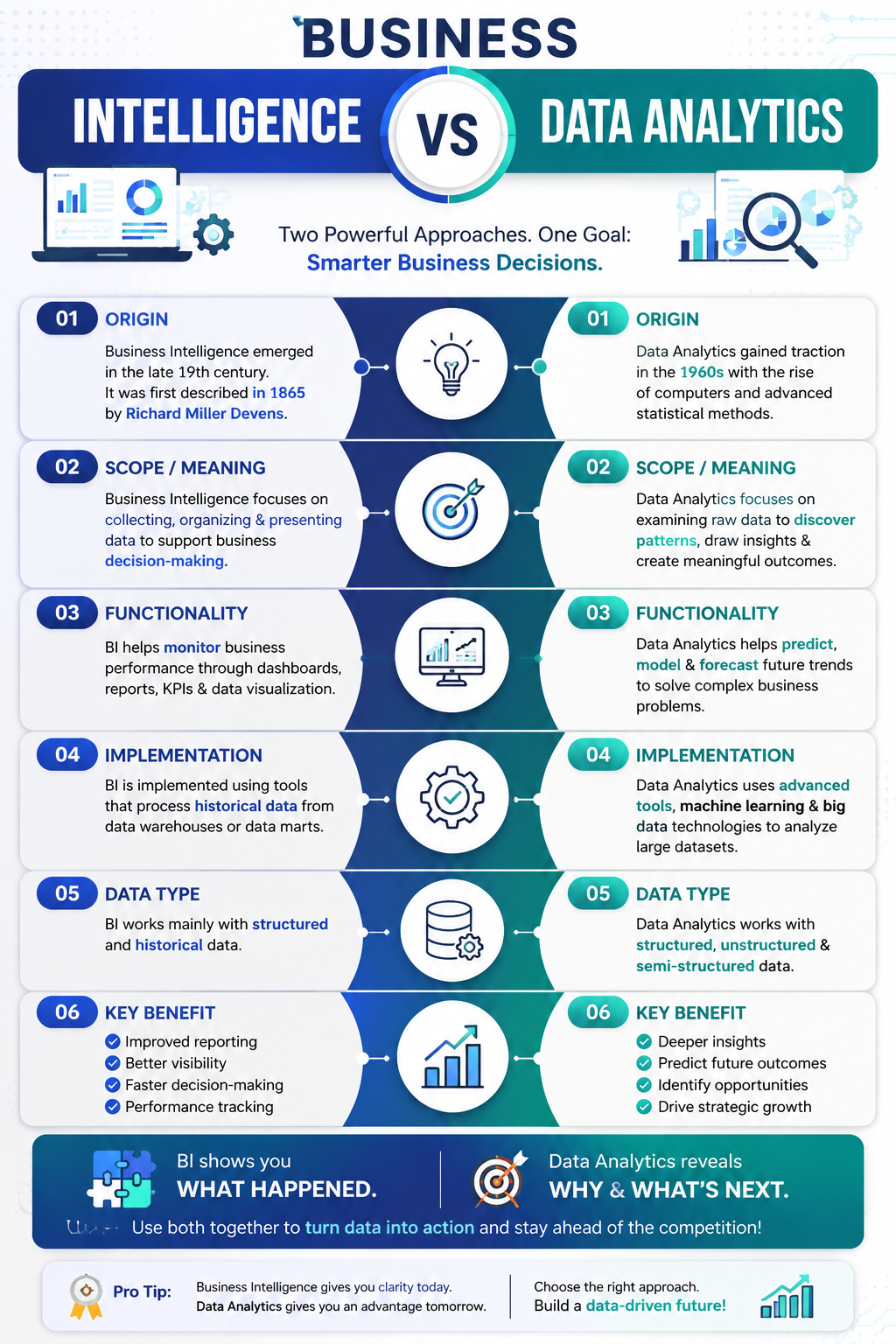
What is Business Intelligence?
Business Intelligence (BI) is a technology-driven process that collects, organizes, analyzes, and presents business data in an easy-to-understand format. It helps organizations monitor performance using dashboards, reports, KPIs, and visualizations.
The primary goal of business intelligence is to answer questions like
- What happened?
- How is the business performing?
- Which department is performing better?
- Which products generate the highest revenue?
- What are our monthly or yearly sales trends?
Business intelligence combines data from multiple sources, including ERP systems, CRM software, HRMS, accounting software, and spreadsheets, into a single dashboard for faster decision-making.
Benefits of Business Intelligence
- Real-time business dashboards
- Faster executive reporting
- Better KPI tracking
- Improved operational visibility
- Data-driven business decisions
- Reduced manual reporting
- Enhanced collaboration across departments
What is Business Data Analytics?
Business Data Analytics is the process of examining historical and current business data using statistical methods, machine learning, predictive models, and data science techniques to identify trends, discover hidden patterns, and forecast future outcomes.
Instead of simply showing what happened, data analytics answers deeper business questions such as:
- Why did sales decline?
- Which customers are likely to leave?
- Which products should we promote next quarter?
- What factors affect profitability?
- What will demand look like next month?
Business Data Analytics enables organizations to make proactive decisions rather than reactive ones.
Benefits of Business Data Analytics
- Predict future business trends
- Identify customer behavior patterns
- Improve forecasting accuracy
- Optimize pricing strategies
- Reduce operational risks
- Support strategic planning
- Increase business profitability
Business Intelligence vs. Business Data Analytics
| Feature | Business Intelligence (BI) | Business Data Analytics (BDA) |
|---|---|---|
| Primary Purpose | Monitor business performance | Predict future outcomes and discover insights |
| Main Question | What happened? | Why did it happen and what will happen next? |
| Focus | Historical and current data | Historical, current, and predictive data |
| Decision Type | Operational decisions | Strategic decisions |
| Reports | Dashboards, KPIs, standard reports | Predictive models, forecasting, statistical analysis |
| Data Complexity | Moderate | High |
| Technologies | Power BI, Tableau, Looker, Qlik | Python, R, SQL, Machine Learning, AI platforms |
| Users | Business owners, executives, managers | Data analysts, business analysts, data scientists |
| Output | Performance monitoring | Predictive insights and recommendations |
| Business Value | Improves visibility and reporting | Improves forecasting and long-term planning |
Which Works Better?
The better choice depends on your business goals.
If your objective is to monitor performance, automate reporting, and gain real-time visibility into your operations, Business Intelligence is the ideal solution.
If your goal is to predict customer behavior, forecast demand, optimize operations, and uncover hidden opportunities, Business Data Analytics provides greater strategic value.
However, for most modern organizations, choosing one over the other is not the best approach.
Business Intelligence and Business Data Analytics complement each other.
Business Intelligence tells you what is happening, while Business Data Analytics explains why it happened and what is likely to happen next.
For example:
- A BI dashboard shows that sales dropped by 15% this quarter.
- Data Analytics identifies the reasons behind the decline and predicts which customer segments are most at risk of leaving.
- Management can then take targeted actions before revenue is affected further.
Businesses that combine Business Intelligence with Data Analytics are better equipped to make faster decisions, improve customer experiences, reduce costs, and stay ahead of competitors.

Business Intelligence Solutions: What They Actually Deliver
Business intelligence is about understanding what already happened in your business. It takes historical data, organizes it, and presents it through dashboards, reports, and scorecards so leadership can make faster, informed decisions.
A retail chain using business intelligence solutions might track daily sales by store location, compare inventory turnover across regions, or flag underperforming product lines within hours instead of weeks. That’s the core value: speed and clarity on what’s already happened.
Here’s what a solid BI implementation typically includes:
-
- Interactive dashboards built through tools like Power BI, Tableau, or Looker
- Automated reporting that eliminates manual spreadsheet work
- Role-based access so executives, managers, and frontline teams see relevant metrics
- Data visualization services that turn raw numbers into charts anyone can interpret in seconds
- Data warehousing and integration from multiple sources (CRM, ERP, POS systems)
Data Analytics Services India: Why Global Companies Are Outsourcing Here
Data analytics goes a step further than BI. Instead of just showing you what happened, it answers why it happened and what’s likely to happen next. This is where statistical modeling, machine learning, and predictive analytics come into play.
India has become one of the largest hubs for data analytics services globally, and it’s not just about cost. The country produces over 2.5 million STEM graduates annually, and its analytics talent pool has deep experience across finance, healthcare, retail, and manufacturing verticals. Companies partnering with data analytics services India providers often get access to specialized skills, like a predictive analytics company that builds custom churn models or demand forecasting engines, at a fraction of what similar expertise costs in the US or UK.
The full lifecycle of a typical data analytics engagement looks like this:
| Phase | What Happens |
|---|---|
| Discovery | Understanding business goals, data sources, and current gaps |
| Data Engineering | Cleaning, structuring, and integrating raw data |
| Model Development | Building predictive or prescriptive models tailored to the problem |
| Validation | Testing model accuracy against historical outcomes |
| Deployment | Integrating models into existing workflows or dashboards |
| Monitoring | Ongoing retraining and performance tracking |
Case in point: A US-based e-commerce brand partnered with a data analytics services India team to reduce cart abandonment. Using predictive analytics, the team identified behavioral patterns 48 hours before customers dropped off, allowing marketing to trigger targeted offers at exactly the right moment. Cart abandonment dropped by 18% within the first quarter.
Frequently Asked Questions
What is the main difference between business intelligence and data analytics?
Business intelligence focuses on understanding past and current performance through dashboards and reports. Data analytics goes further, using statistical models and machine learning to predict future outcomes. Most companies need both working together, not one instead of the other.
How do I know if my company needs BI or predictive analytics first?
Start with BI if you lack visibility into current operations. Add predictive analytics once you have clean, reliable data and specific forward-looking questions, like demand forecasting or churn prediction, that historical reports can’t answer alone.
Why does outsourcing to data analytics services India make sense?
India offers a deep, experienced talent pool across industries at competitive rates. Many providers have built predictive models and BI systems for global clients across finance, retail, and healthcare, giving them practical experience beyond theoretical knowledge.
Can Power BI consulting help if we already have a BI tool?
Yes. Many companies license Power BI but never configure it properly. Consulting helps you build clean data models, meaningful visualizations, and role-based dashboards that actually get used instead of ignored.
Should I hire an in-house analytics team or use a service provider?
It depends on your data maturity and budget. Service providers offer flexibility and specialized skills without long-term overhead. In-house teams make sense once analytics becomes central to daily operations and you need constant, embedded expertise.
Final Thoughts
In today’s competitive business environment, data is one of the most valuable assets an organization possesses. Simply collecting data is no longer enough. Companies need technologies that transform information into actionable insights.
Business Intelligence helps organizations understand their current performance through reports, dashboards, and KPIs. Business Data Analytics goes a step further by uncovering trends, identifying opportunities, and predicting future outcomes.
For business owners, executives, and technology decision-makers, the smartest investment is often a solution that integrates both Business Intelligence and Business Data Analytics. Together, they enable organizations to move beyond reporting and build a culture of informed, data-driven decision-making that supports sustainable growth.
Whether you are a growing startup, an SME, or a large enterprise, adopting the right mix of BI and data analytics can improve efficiency, increase profitability, and provide the confidence needed to make strategic business decisions in a rapidly changing market.