Ai consultants

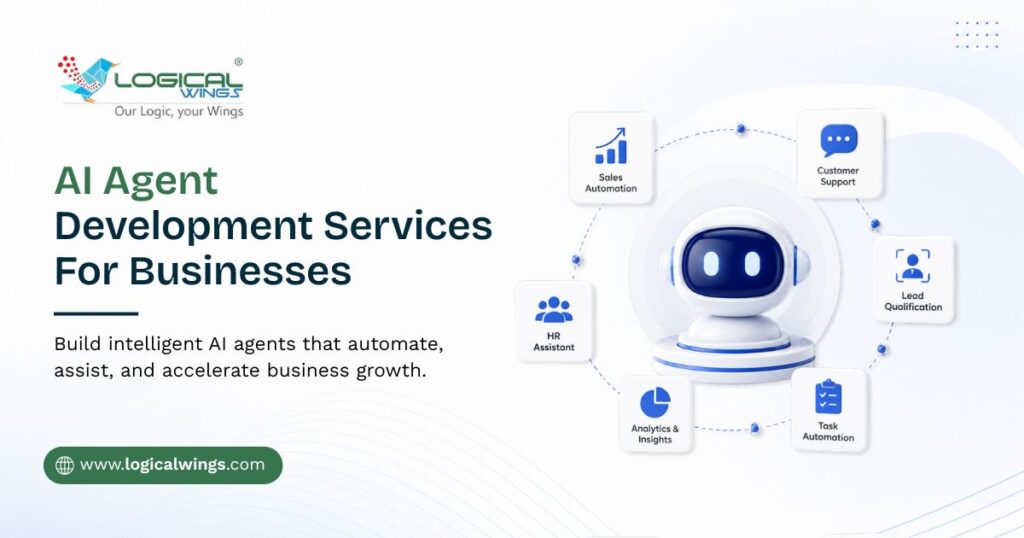
AI Agent Development Services For Businesses

AI Agent Development Services For Businesses

Most software automates what you tell it to do. AI agents automate what you’re trying to accomplish. That’s the practical difference. A traditional workflow tool follows a fixed script—if this, then that. An AI agent development service that receives a goal, figures out the steps required to reach it, uses whatever tools are available, adapts when something doesn’t go as expected, and completes the task. The script writes itself. For businesses, the implication is significant. Work that previously required human judgment at every step — not just execution, but decision-making — can now be delegated to a system that reasons through the problem the same way a capable employee would. This article covers what AI agents are, how they work, the types available, where they’re being used across industries, how a development engagement actually runs, and what businesses gain from implementing them—including whether you need a technical team to get started. What Is an AI Agent and How Do AI Agents Work? An AI agent is a software system that perceives its environment, sets or receives a goal, plans the actions needed to achieve it, executes those actions using available tools, and adjusts based on what it observes along the way. The architecture behind a working agent has four core components. The reasoning engine is the large language model at the center — the part that interprets goals, generates plans, evaluates outputs, and decides what to do next. This is where models like GPT-4, Claude, or Gemini sit. The model alone isn’t an agent. It becomes one when it’s connected to the components below. The tool layer gives the agent the ability to act on the world rather than just describe it. Tools are functions the agent can call: search the web, read a database record, write to a CRM, send an email, execute a calculation, or call an external API. Every real-world capability the agent has comes through a tool. Without tools, a model is a text generator. With them, it’s an operator. The memory system determines what the agent knows and retains. Short-term memory is the current conversation context—what’s happened so far in this task. Long-term memory is stored and retrieved from external systems: past interactions, user preferences, and organizational knowledge bases. Agents that handle complex or ongoing tasks need to function reliably. The orchestration layer coordinates the whole loop. It manages the sequence of reasoning, tool use, observation of results, and replanning when a step fails or returns unexpected output. This is what makes an agent genuinely autonomous rather than just a sequence of pre-scripted API calls. What Are the Types of AI Agents? Not all agents are built the same way or suited for the same problems. Understanding the categories helps match the right architecture to the right use case. Simple reflex agents operate on immediate inputs without memory or planning. They follow condition-action rules: if the input matches a pattern, execute the defined response. These are fast and predictable but break the moment the situation falls outside their programmed conditions. Useful for narrow, well-defined tasks with limited variability. Model-based reflex agents maintain an internal model of their environment, allowing them to handle situations where the full context isn’t visible in the current input. They track state over time rather than reacting to each input in isolation. Better suited for tasks where context from earlier in the interaction matters. Goal-based agents reason about what actions will move them toward a defined objective. They evaluate possible actions not just by what the current state is but by what state they’re trying to reach. This is where genuine planning behavior emerges — the agent considers multiple paths and selects based on which one leads to the goal. Utility-based agents go a step further, evaluating actions not just by whether they achieve the goal but by how well they achieve it. Where multiple paths lead to the goal, the agent selects the one that maximizes a defined utility function—minimizing cost, maximizing speed, or balancing competing constraints. These are the basis for optimization-heavy enterprise applications. Learning agents improve over time based on feedback. They observe the outcomes of their actions, update their internal models accordingly, and perform better on subsequent similar tasks. Production enterprise agents increasingly incorporate learning mechanisms so the system improves with use rather than requiring manual retraining for every new pattern it encounters. Multi-agent systems deploy multiple specialized agents that collaborate on complex tasks. One agent might handle research, another drafts output, a third reviews for accuracy, and a fourth executes the approved action. This architecture produces better results on tasks that benefit from specialization and parallel processing—and mirrors how human teams actually work. Top AI Agent Use Cases Across Industries The use cases that have moved from proof-of-concept into production fall into recognizable patterns across sectors. Financial Services  Invoice processing agents extract line items from incoming documents, match them against purchase orders, flag discrepancies, and route exceptions for human review—eliminating a category of manual data entry that consumes significant analyst time. Credit and risk assessment agents pull data from multiple sources, apply scoring models, and generate structured reports for human decision-makers. Fraud detection agents monitor transaction patterns in real time, cross-reference against behavioral baselines, and trigger alerts or automatic holds without waiting for a batch review cycle. Healthcare  Prior authorization agents handle the administrative process of requesting insurance approvals for procedures—collecting clinical documentation, checking payer criteria, submitting requests, and following up on pending decisions. Patient scheduling agents manage appointment bookings, rescheduling, and reminders across multiple provider calendars. Clinical documentation agents listen to provider-patient interactions and generate structured notes, reducing the documentation burden that contributes significantly to clinician burnout. Legal and Compliance  Contract review agents scan incoming agreements for non-standard clauses, flag deviations from approved templates, and surface relevant precedents from the firm’s document library. Regulatory monitoring agents track changes to applicable rules across jurisdictions and generate impact summaries for compliance teams. Due diligence agents aggregate and analyze information across public filings, news sources, and internal databases to

AI Agent Development Services For Businesses Read More »

AI Services

Ai services consultant

Complete Guide – AI Services For Your Business in 2026

Artificial Intelligence has quickly become the backbone of modern business transformation. From predictive analytics and intelligent automation to personalized user experiences and real-time decision-making, AI is not just a trend—it is a strategic necessity. Whether a company operates in healthcare, retail, finance, logistics, or hospitality, AI is reshaping how organizations solve problems, serve customers, and scale operations. This guide breaks down AI with clarity and depth. You’ll understand the types of AI, core applications, benefits for customer service and healthcare, and the rising importance of AI voice assistants for businesses. Whether you’re exploring ai services near me, researching ai service providers, or evaluating an ai service consultant in UAE and USA, this article offers the insights needed to make informed decisions. What Are AI Services? AI services refer to specialized solutions built using artificial intelligence technologies to automate tasks, analyse data, enhance decision-making, and improve operational efficiency. These services can include: Machine learning model development Predictive data analytics Natural language processing Computer vision applications AI chatbot systems Intelligent process automation AI services help businesses solve real-world challenges by reducing workload, eliminating human error, and enabling faster insights. How Much Do AI Services Cost? The cost of AI services varies significantly based on the complexity, required integrations, project duration, and type of AI model needed. On average: Small AI projects (basic chatbots, automation tools): $2,000 – $15,000 Medium-scale AI solutions (recommendation engines, NLP systems): $20,000 – $90,000 Enterprise-level AI platforms (predictive analytics, advanced machine learning): $100,000 – $500,000+ Additional cost factors include: ✔ Data preparation and cleansing ✔ Infrastructure or cloud usage fees ✔ Model training and optimization ✔ Ongoing maintenance Businesses should partner with trusted ai service providers who offer transparent pricing and a clear roadmap. AI Services: How They Transform Modern Workflows Businesses today operate in an environment where speed, accuracy, and user personalization are key success drivers. AI services bridge the gap between manual processes and intelligent automation, helping companies work smarter rather than harder. By integrating AI into their workflow, organizations can streamline operations, automate tedious tasks, and achieve measurable improvements in performance. Whether it’s predictive analytics in finance, machine learning in retail, or automated diagnostics in healthcare, AI enables a future-ready approach that ensures businesses remain competitive. Companies can also build scalable solutions tailored to their industry, creating long-term value that grows along with their business strategy. What Are the Four Types of AI? AI is categorized into four major types based on capabilities and intelligence levels: 1. Reactive Machines Basic AI systems that follow predefined rules and do not learn from past data (e.g., simple automation tools). 2. Limited Memory AI Most widely used today; these systems learn from historical data—like recommendation engines and self-learning chatbots. 3. Theory of Mind AI A more advanced concept where AI understands human emotions and behavioural patterns (still in development stages). 4. Self-Aware AI Theoretical AI with consciousness and self-awareness, not currently existing. Understanding these helps businesses choose the right AI model for their needs. AI in Healthcare: A New Era of Smart Medicine The integration of AI in healthcare is reshaping how medical professionals diagnose, treat, and monitor patients. AI-powered systems reduce the burden on doctors by quickly analysing medical images, identifying patterns in patient records, and predicting potential health risks before they escalate. Hospitals can automate administrative tasks, streamline appointment management, and monitor patient vitals in real time using AI-driven devices. This improves medical accuracy, enhances patient satisfaction, and accelerates critical decision-making. AI’s potential in life-saving interventions and operational efficiency continues to expand, making it one of the most transformative technologies in healthcare. Key Benefits of AI for Customer Service Teams Benefit Impact on Business Faster response times Reduced waiting time and improved CX 24/7 availability Continuous support without additional staffing Personalized interactions Higher customer satisfaction Lower operational costs Reduced human workload and resource usage Multi-language support Global customer reach Data-driven insights Better decision-making and customer retention AI in Customer Support: The New Standard for Engagement Customer service has transformed significantly with the emergence of AI-driven systems. Intelligent chatbots, sentiment analysis tools, and automated workflows help brands deliver a seamless experience from the first interaction to post-service follow-up. Instead of waiting for a human agent, customers receive instant replies, faster ticket resolutions, and more accurate information. AI also enables businesses to understand customer behaviour deeply, giving them actionable insights to refine their services. Over time, this leads to stronger loyalty, consistent service quality, and reduced operational costs—making AI a crucial asset in customer-driven industries. Benefits of AI Voice Chatbot Assistants for Business Feature Value Delivered Hands-free communication Faster operations Automated call handling Better customer experience Integrated scheduling Higher productivity Natural language interactions User-friendly experience Workflow automation Streamlined internal processes What Is the Best AI Service? The best AI service depends entirely on a company’s goals, industry requirements, and customer expectations. However, some widely recognized categories include: Predictive analytics for data-driven decisions AI-powered automation to reduce human workload NLP-based chatbots for 24/7 customer support Computer vision tools for security, scanning, and image detection Voice-based assistants for hands-free business operations The ideal solution must offer accuracy, scalability, faster processing, and measurable ROI. AI Voice Chatbot Assistant for Business Voice chatbot assistants are becoming essential across industries because they simplify communication through natural, conversational commands. Businesses use them to: Automate customer calls Support hands-free operations Manage internal workflows Handle appointment scheduling Collect user queries efficiently AI voice assistants strengthen brand accessibility and improve productivity in day-to-day operations. AI to Improve Customer Service AI is transforming customer service by delivering faster, more reliable, and highly personalized interactions. Companies can use AI to: Respond instantly through digital assistants Analyse customer history and offer tailored solutions Automate repetitive queries Reduce waiting times Provide multilingual support AI enables businesses to create seamless customer journeys while improving overall satisfaction. Benefits of AI in Customer Service AI brings several measurable advantages: 1. Faster Response Time Chatbots and automated systems reduce wait times drastically. 2. 24/7 Support Businesses can assist customers anytime—even outside business hours. 3.

Complete Guide – AI Services For Your Business in 2026 Read More »

AI Services
Scroll to Top