
One business builds a customer portal in React. Another builds an enterprise CRM in Angular. Both ship on time. Both work well. Neither team regrets the choice because they picked the framework that matched their problem, not the one that won the last Twitter debate.
That’s the right frame for this comparison. React and Angular aren’t competing for the title of “better framework.” They’re optimized for different kinds of projects, different team structures, and different business requirements. Choosing between them without understanding those distinctions is how you end up hiring the wrong developers, setting the wrong expectations, and refactoring six months into a build. Here’s what the comparison actually looks like for businesses making a real decision.
What You’re Actually Choosing Between
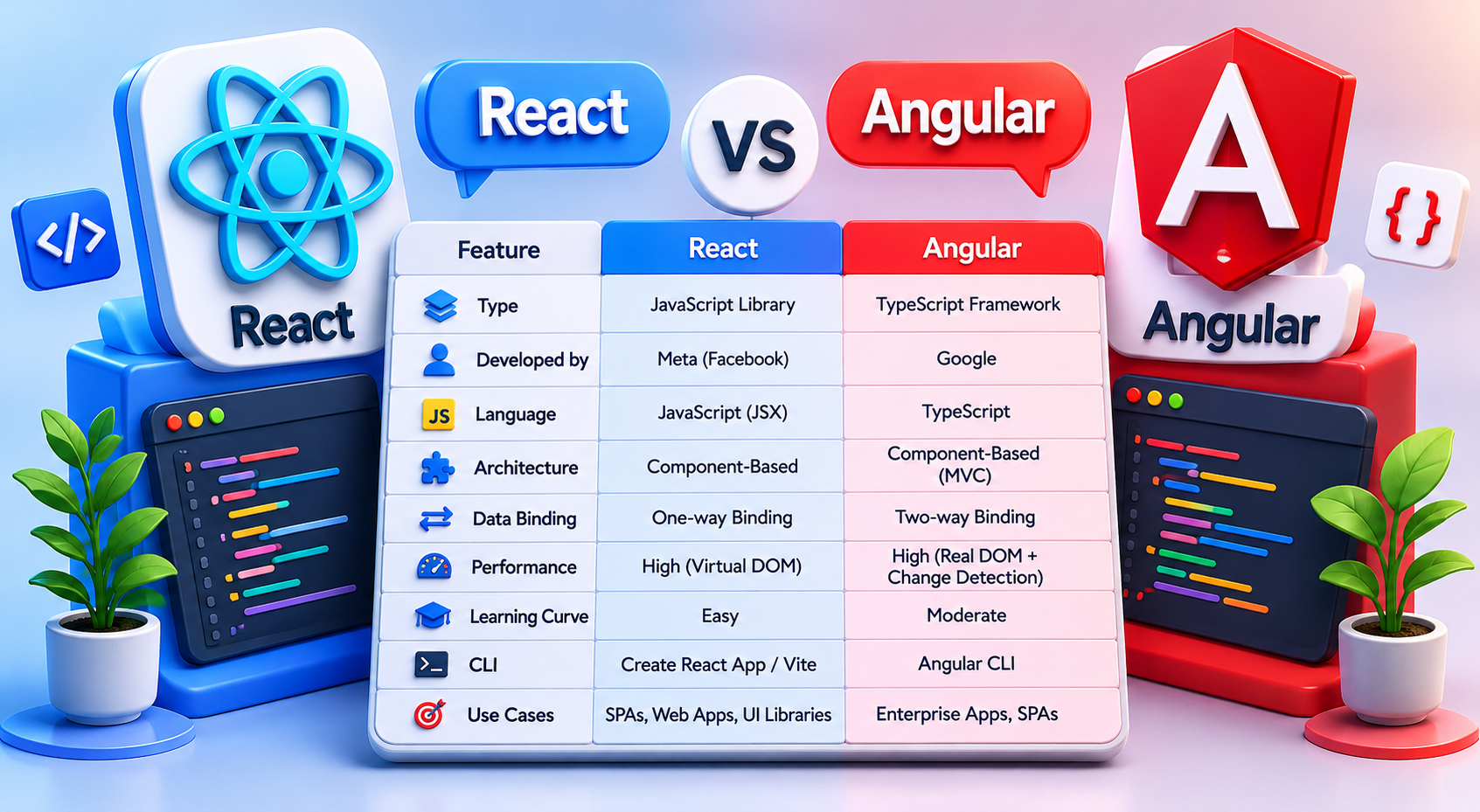
React is a JavaScript library developed and maintained by Meta. It handles the UI layer, how data gets rendered to the screen, and how the interface responds to user interactions. React gives developers significant freedom in how they structure the rest of the application: routing, state management, data fetching, and architecture are handled by choosing and integrating additional libraries. That flexibility is both the appeal and the complexity.
Angular is a full framework developed and maintained by Google. It comes with opinions built in a defined way to handle routing, forms, HTTP requests, state management, dependency injection, and application structure. A developer working in Angular follows Angular’s conventions. The framework makes many decisions for them, which means less configuration upfront and more consistency across a team.
The practical difference:
React gives you a foundation and lets you build the house however you want. Angular gives you a blueprint and expects you to follow it. Both houses can be well-built. The question is which approach fits your team and your project.
A note on terminology:
Angular.js (the original 2010 framework) and Angular (the complete rewrite released in 2016, currently on version 17+) are different products. Angular.js is legacy software in maintenance mode. Modern “Angular” development refers to Angular 2+. This article addresses the current Angular framework throughout.
Architecture and Structure
Angular enforces structure. Every Angular application follows the same component-module-service architecture. A developer hired from any Angular project can navigate a new Angular codebase with minimal orientation because the conventions are consistent. TypeScript is mandatory, dependency injection is built in, and the CLI generates scaffolding that keeps projects organized as they grow.
React enforces almost nothing beyond the component model. Two React codebases built by different teams can look completely different — different state management approaches (Redux, Zustand, Jotai, Context API), different routing libraries (React Router, TanStack Router), different data fetching patterns (SWR, React Query, plain fetch). This is freedom for experienced teams who know what they’re doing. It’s a source of inconsistency and technical debt for teams without strong architectural leadership.
For businesses building large-scale enterprise applications with multiple developers over multi-year timelines, Angular’s enforced consistency is a genuine operational advantage. Code reviews are more meaningful when there’s a shared standard. Onboarding new engineers is faster when the codebase follows predictable patterns.
For businesses building products that need to move fast, iterate on UI frequently, or leverage a large existing React developer base, React’s flexibility enables speed that Angular’s structure sometimes impedes.
Learning Curve and Developer Productivity
React’s core concept components that render based on props and state can be learned in a day. A developer comfortable with JavaScript can build a working React interface in a week. The library itself is small and focused.
The complexity arises when building a complete application. Choosing, learning, and integrating the ecosystem libraries adds time. Developers new to React often spend significant time on decisions that Angular makes automatically: how to manage global state, how to handle side effects, and how to structure the project at scale.
Angular has a steeper initial climb. TypeScript proficiency is required before productivity kicks in. The concepts of NgModules, decorators, dependency injection, RxJS observables, and Angular’s change detection mechanism take time to absorb. A developer new to Angular should expect four to eight weeks before they’re consistently productive.
After that curve, Angular developers tend to move faster on complex application logic because the framework handles the architectural plumbing. The configuration overhead that slows React teams on large projects doesn’t exist—Angular already decided. For short-duration projects with experienced teams, React’s immediate productivity gains are clear. For long-duration enterprise builds where consistency and maintainability matter more than initial speed, Angular’s upfront investment pays back.
Performance
Both frameworks are performant enough for the vast majority of business applications. The benchmark differences between them in controlled tests don’t translate into perceptible differences for users interacting with dashboards, forms, data tables, or workflow interfaces.
React uses a virtual DOM and reconciliation algorithm to minimize actual DOM updates. For applications with frequent, fine-grained UI updates, real-time data feeds, interactive charts, and collaborative editing, React’s granular re-rendering control is an advantage.
Angular uses a Zone.js-based change detection system that tracks all asynchronous operations and re-evaluates component state accordingly. For most application patterns, this works efficiently. For applications with very high update frequency, developers use the OnPush change detection strategy to optimize performance, which requires intentional configuration rather than being automatic.
React’s newer concurrent features (Suspense and concurrent rendering) give it an edge for complex user interface scenarios involving heavy computation alongside rendering. For standard business application interfaces, the performance difference is academic.
Ecosystem and Library Support
React has the larger ecosystem by a significant margin. The npm registry contains more React components, hooks, integrations, and utility libraries than Angular equivalents. For common requirements, data visualization, rich text editing, drag-and-drop interfaces, date pickers, data grids, authentication flows, React libraries exist, are actively maintained, and have large user communities.
The trade-off is ecosystem fragmentation. When five popular libraries solve the same problem in different ways, teams spend time evaluating options and occasionally pick the wrong ones. The React ecosystem rewards developers who know it well and creates overhead for teams navigating it for the first time.
Angular’s ecosystem is smaller but more coherent. Angular Material provides a comprehensive, Google-maintained component library that covers most UI requirements without reaching for third-party packages. The Angular CDK (Component Development Kit) provides building blocks for custom components. For teams that want most of their dependencies to come from a single, well-maintained source, Angular’s first-party ecosystem reduces dependency management complexity.
React Developers vs Angular Developers
This is where the business decision gets practical.
Hire React developers, and you’re drawing from the largest frontend talent pool in the market. React has been the dominant frontend framework for several years running, with consistent top rankings in developer surveys. More bootcamp graduates learn React. More senior frontend engineers have React as their primary skill. When you need to scale a team, find contract help, or replace someone who leaves, React’s talent market is deeper.
React developers vary significantly in seniority and architectural thinking. Because React doesn’t enforce structure, a junior React developer who doesn’t understand application architecture can produce hard-to-maintain code that looks fine until the project reaches complexity. When you hire React developers, assessing architectural judgment matters as much as React syntax knowledge.
Hire Angular.js developers, or more accurately, hire Angular developers for the current framework, and you’re working with a smaller but often more architecturally consistent pool. Angular’s enforced conventions mean that a developer who knows Angular well writes code that fits recognizable patterns. The framework itself creates a floor on structural quality that React doesn’t provide.
Angular developers tend to come from enterprise software backgrounds more than React developers do. They’re accustomed to TypeScript-first development, large codebase navigation, and the kind of long-term maintainability thinking that enterprise projects require. For businesses building internal enterprise tools, complex back-office systems, or applications that will be maintained for five-plus years, Angular developer profiles often align better with what the project needs.
The hiring supply difference is real. Hiring two React developers takes less time than hiring two Angular developers in most markets. For businesses with tight timelines or in regions where Angular talent is sparse, React’s larger hiring pool is a practical advantage worth weighing.
Testing
Angular ships with testing infrastructure included. Jasmine and Karma are configured by default. The framework’s dependency injection system makes unit testing service logic straightforward because dependencies can be swapped for mocks without complex configuration. Testing in Angular is more consistent across teams because the approach is prescribed rather than chosen.
React testing requires assembling a setup: Jest for the test runner, React Testing Library for component testing, and additional tooling for specific requirements. The combination is well-established and widely documented, but it’s a setup step that Angular doesn’t require. Once configured, React Testing Library’s focus on testing behavior rather than implementation details produces tests that are more resilient to refactoring.
For teams prioritizing testable, maintainable code from the start, both frameworks support it well. Angular removes the configuration barrier. React requires configuration but gives slightly more flexibility in testing approach.
When React Is the Right Choice for Your Business
React fits when the team is building a product-led application where UI flexibility, iteration speed, and access to a wide component ecosystem matter. Startups building consumer-facing products, businesses creating marketing-heavy interfaces, teams that need to prototype and pivot quickly, and organizations that want access to the widest possible hiring pool benefit from React.
React is also the right choice when the team already has React expertise and the project scope doesn’t require the structural enforcement that Angular provides. Rebuilding institutional knowledge around a new framework has real costs. If the existing team builds well in React, the default should be React.
When you hire React developers for these projects, prioritize candidates who can articulate state management decisions, understand when to reach for context versus external state libraries, and have demonstrated experience with performance optimization on non-trivial applications.
When Angular Is the Right Choice for Your Business
Angular fits when the application is large, complex, and built by a team that will grow and turn over over time. Enterprise internal tools, large-scale SaaS platforms with complex business logic, applications that need consistent architecture across multiple development teams, and projects where TypeScript’s type safety is a genuine operational requirement — these are Angular’s domain.
Angular is also the right choice when the alternative is React without strong architectural leadership. A large React codebase built without enforced conventions by a team without deep React architecture experience frequently produces maintainability problems that Angular’s structure would have prevented. If the team is large or the project is long, Angular’s opinionated nature is protective.
When you hire Angular developers for these projects, look for experience with RxJS and reactive patterns, comfort with TypeScript’s advanced type system, and familiarity with Angular’s change detection model. These are the skills that separate Angular developers who can handle complexity from those who’ve only worked on simple CRUD applications.
How to choose a framework for web development?
Choose React if:
- The application is consumer-facing, UI-intensive, or requires frequent design iteration
- The team already has React expertise, and there’s no compelling reason to switch
- Hiring speed and talent availability are constraints
- The project needs extensive third-party integrations and benefits from React’s larger ecosystem
- The build is short-to-medium duration, with an experienced team that can manage architectural decisions
Choose Angular if:
- The application is enterprise-scale with complex business logic and multi-year maintenance expectations
- Multiple development teams need to work on the same codebase with consistent conventions
- TypeScript-first development and strong typing are requirements, not preferences
- The team wants a framework that makes architectural decisions rather than having to make them
- The build involves a large, growing team where structural consistency matters more than flexibility
The honest summary: React is the pragmatic choice for most web and application projects where team size is manageable and UI flexibility matters. Angular is the right investment for enterprise-scale builds where structural consistency, long-term maintainability, and TypeScript rigor are non-negotiable. Neither choice is wrong when it’s made against the right criteria.
If the business requirement is cross-platform mobile native iOS and Android, neither React nor Angular is the primary answer. React Native (separate from React for web) handles that territory. Angular doesn’t have a maintained native mobile equivalent. That’s a different technology decision, and it should be evaluated separately.
5 Questions to Ask Before You Decide
How large will the team be at peak?
Small teams with strong developers can manage React’s flexibility. Large teams with varied experience levels benefit from Angular’s enforced consistency.
How long will this codebase be maintained?
Projects with three-plus-year lifespans benefit from Angular’s structural standards. Shorter-duration or higher-iteration projects favor React’s speed.
What does the existing team know?
Framework transitions have real costs. The right choice for a greenfield project might be wrong for one that continues existing work.
Is hiring speed a constraint?
If you need to staff up quickly, React’s larger talent pool is a practical advantage. Plan accordingly.
What does the application actually do?
Form-heavy enterprise applications with complex business rules fit Angular’s model well. Data-rich, visually dynamic product interfaces fit React’s model. Match the framework to the application’s nature, not to industry trends.