Most chatbot projects don’t fail because the technology isn’t ready. They fail because the wrong partner built the wrong thing for the wrong reason. A team spends six months and a healthy budget on a bot that answers three questions well and everything else with “I didn’t quite catch that.” The result sits on a support page, gathering complaints, until someone quietly turns it off.
Choosing an AI chatbot development company is less about who can code a conversational interface and more about who understands your workflows, your data, and where a bot genuinely helps versus where it just adds friction. This piece walks through what a capable partner actually does, how to evaluate one, and when building a chatbot is the right call in the first place.
What an AI Chatbot Development Company Actually Delivers
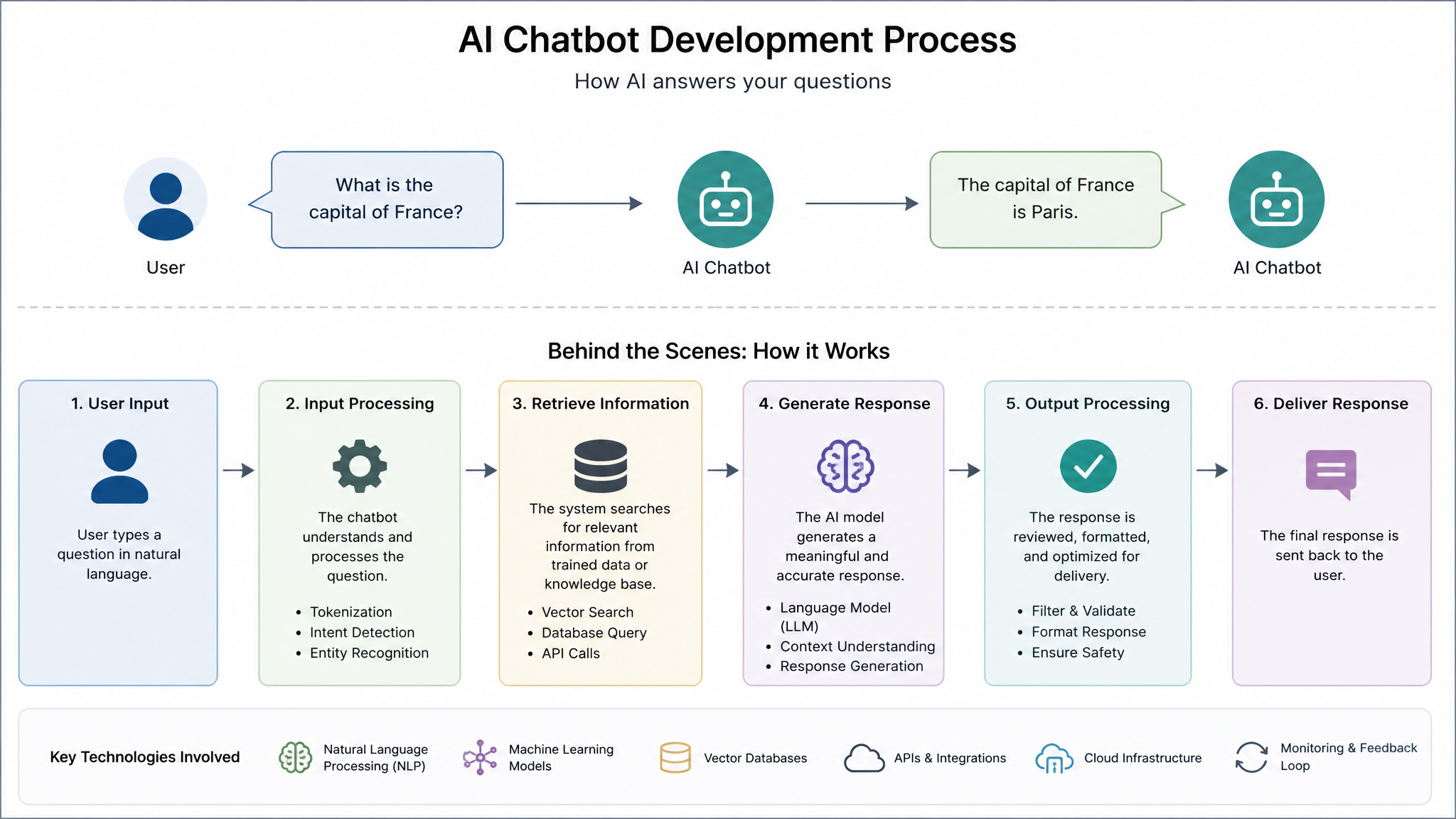
Strip away the marketing language and the job comes down to three things: understanding intent, connecting to your systems, and handling the messy edge cases that real users create.
Intent recognition is the part most people picture. The bot reads a message and figures out what the person wants. Modern large language models made this dramatically easier than it was even a few years ago, which is exactly why the bar has shifted. Recognizing intent is now table stakes. The harder work sits underneath.
Connecting to your systems is where projects live or die. A support bot that can’t check an order status, look up an account, or trigger a refund is just a slower FAQ page. A good development team spends significant time on integrations: your CRM, your ticketing platform, your internal databases, your authentication layer. This plumbing is unglamorous and it’s usually where the real budget goes.
Then there’s the long tail of edge cases. What happens when a user asks something out of scope? When they get angry? When the model hallucinates an answer that sounds confident but is wrong? A serious partner designs guardrails, fallback paths, and human handoff points from day one, not as an afterthought when complaints start rolling in.
Why Choosing the Right AI Chatbot Development Company
The tooling has largely commoditized. Most competent teams can work with the same foundation models, the same vector databases, the same orchestration frameworks. What separates a useful bot from an abandoned one is judgment, and judgment comes from the team, not the stack.
Consider two hypothetical teams building the same customer support bot for a mid-sized e-commerce business. Both use the same underlying model. The first team ships fast, wires up a chat window, and calls it done. The second spends the first two weeks reading actual support tickets, mapping the ten most common request types, and deciding which three should never be automated because they involve refunds above a certain threshold. Six months later, the second bot is deflecting a meaningful share of tickets and the first is switched off. Same technology, completely different outcome.
This is the real reason the choice of partner matters. You’re not buying a chatbot. You’re buying a set of decisions about what to automate, how to fail gracefully, and how to measure whether the thing is actually working.
How to Evaluate an AI Chatbot Development Partner
Vendor selection tends to drift toward whoever gives the slickest demo. Demos are easy to stage. What you want to probe is how the team behaves when the project gets complicated.
Here are the areas worth pressing on during evaluation:
-
- Discovery depth. A team that quotes a fixed price and timeline before understanding your data, your systems, and your support volume is guessing. Real discovery involves looking at your actual conversations and workflows, not just a requirements document you filled out.
-
- Integration experience. Ask specifically which platforms they’ve connected to before, and how they handle authentication, rate limits, and data that lives in legacy systems. Integration horror stories reveal far more than feature lists.
-
- Handling of hallucination and accuracy. For any bot touching customer-facing information, ask how they ground responses in your actual data and what they do to prevent confident-but-wrong answers. If the answer is vague, that’s a signal.
-
- Ownership and lock-in. Clarify who owns the code, the training data, and the conversation logs. Some vendors build on proprietary platforms that make it expensive to leave. Know this before you commit.
- Post-launch support model. A chatbot is not a one-time build. It needs tuning as users find new ways to break it. Understand how the team handles the first ninety days after launch, when most of the real learning happens.
The teams worth hiring will welcome these questions. The ones to avoid will try to steer you back to the demo.
When AI Chatbot Development Is the Right Fit, and When It Isn’t
Not every problem needs a chatbot, and a partner willing to tell you that is more trustworthy than one who says yes to everything.
Chatbots earn their keep when you have high volume, repetitive queries, and structured data behind them. Order tracking, appointment scheduling, password resets, product lookups, first-line qualification of leads. These are patterns where users ask predictable things and the answers live in systems you can reach programmatically.
They struggle when the queries are highly emotional, legally sensitive, or genuinely novel each time. A bot handling a billing dispute where a customer is already frustrated will usually make things worse. A bot fielding nuanced medical or legal questions creates liability you don’t want. In these cases, the right build is often a hybrid: the bot triages, gathers context, and routes to a human quickly, rather than pretending it can resolve everything.
The point is that scope discipline matters more than ambition. A bot that handles the top five request types flawlessly beats one that attempts fifty and does most of them badly.
| Scenario | Good chatbot fit? | Why |
|---|---|---|
| High-volume, repetitive support queries | Strong | Predictable intents and answers live in reachable systems |
| Lead qualification and routing | Strong | Structured questions, clear handoff to sales |
| Internal knowledge lookup for staff | Good | Bounded knowledge base, forgiving audience |
| Emotionally charged complaints | Poor | Escalation usually beats automation |
| Complex, one-off custom requests | Poor | Too little pattern for reliable automation |
What a Realistic Project Timeline Looks Like
Expectations get set badly early, so it helps to know roughly how these projects actually run.
Discovery and scoping typically take a few weeks for anything beyond a trivial bot. This is where the team studies your conversations, agrees on which intents to automate, and maps the integrations. Rushing this stage is the single most common cause of expensive rework later.
The build itself varies with integration complexity. A bot that only reads from a knowledge base moves faster than one that has to write to your CRM, process transactions, or authenticate users securely. A useful mental model: the conversational layer is often the quickest part, and the integration and testing layers consume the majority of the effort.
Then comes the phase most vendors underplay. After launch, real users behave in ways no test script anticipated. They phrase things strangely, ask off-topic questions, and find the gaps. The first several weeks post-launch are about watching real transcripts, tuning responses, and tightening fallback logic. Budget for this. A partner who treats launch as the finish line is setting you up for the abandoned-bot outcome.
The Cost Conversation Nobody Frames Honestly
Pricing for AI chatbot development ranges widely, and the range is honest rather than evasive because the work genuinely varies that much. A simple FAQ bot on a single platform is a different animal from a multi-channel assistant integrated across several backend systems with strict accuracy requirements.
A few things drive cost more than people expect. Integration count and complexity, first. Every system the bot touches adds engineering and testing. Accuracy requirements, second. A bot where a wrong answer is merely annoying costs less to build than one where a wrong answer creates financial or legal exposure, because the latter needs far more rigorous grounding and testing. Ongoing model and hosting costs, third. Usage-based pricing on the underlying models means your monthly bill scales with conversation volume, which is easy to forget during a fixed-price build discussion.
Be wary of quotes that are dramatically lower than the rest of the field. Sometimes that’s genuine efficiency. More often it means the scope has been quietly narrowed, or the post-launch tuning that determines success has been left out of the number entirely.
Where Logical Wings Fits
Logical Wings works as an AI chatbot development company for teams that want a partner focused on outcomes rather than a demo that photographs well. The emphasis is on the parts that actually decide whether a bot survives contact with real users: honest scoping, solid integration into your existing systems, grounded responses that reduce the risk of confident-but-wrong answers, and a post-launch tuning process rather than a build-and-vanish handoff.
If you already know a chatbot fits your workflow, the conversation is about doing it well. If you’re not sure it fits at all, that’s a conversation worth having too, because the right answer is sometimes a narrower build or a different tool entirely.