Ai Agent Development Services

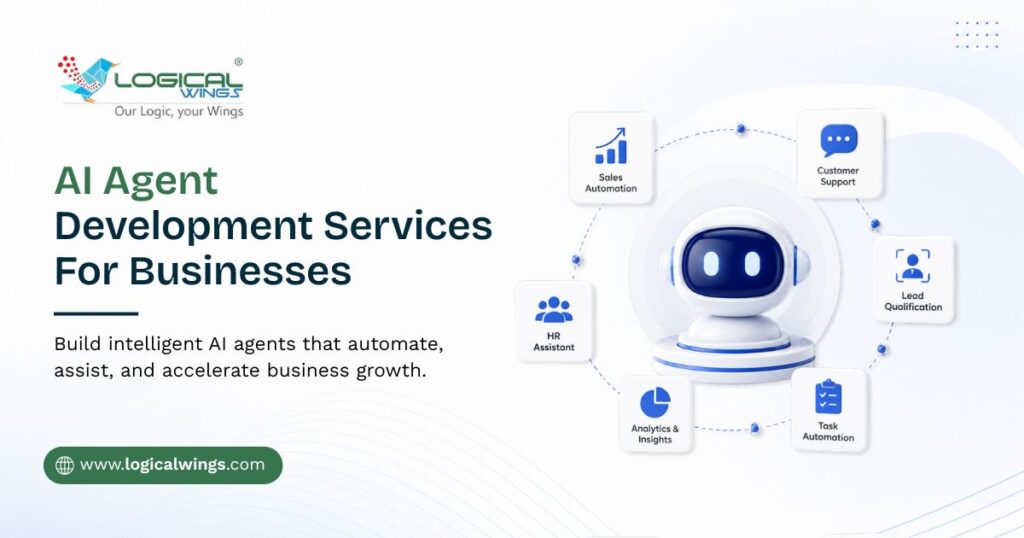
AI Agent Development Services For Businesses

AI Agent Development Services For Businesses

Most software automates what you tell it to do. AI agents automate what you’re trying to accomplish. That’s the practical difference. A traditional workflow tool follows a fixed script—if this, then that. An AI agent development service that receives a goal, figures out the steps required to reach it, uses whatever tools are available, adapts when something doesn’t go as expected, and completes the task. The script writes itself. For businesses, the implication is significant. Work that previously required human judgment at every step — not just execution, but decision-making — can now be delegated to a system that reasons through the problem the same way a capable employee would. This article covers what AI agents are, how they work, the types available, where they’re being used across industries, how a development engagement actually runs, and what businesses gain from implementing them—including whether you need a technical team to get started. What Is an AI Agent and How Do AI Agents Work? An AI agent is a software system that perceives its environment, sets or receives a goal, plans the actions needed to achieve it, executes those actions using available tools, and adjusts based on what it observes along the way. The architecture behind a working agent has four core components. The reasoning engine is the large language model at the center — the part that interprets goals, generates plans, evaluates outputs, and decides what to do next. This is where models like GPT-4, Claude, or Gemini sit. The model alone isn’t an agent. It becomes one when it’s connected to the components below. The tool layer gives the agent the ability to act on the world rather than just describe it. Tools are functions the agent can call: search the web, read a database record, write to a CRM, send an email, execute a calculation, or call an external API. Every real-world capability the agent has comes through a tool. Without tools, a model is a text generator. With them, it’s an operator. The memory system determines what the agent knows and retains. Short-term memory is the current conversation context—what’s happened so far in this task. Long-term memory is stored and retrieved from external systems: past interactions, user preferences, and organizational knowledge bases. Agents that handle complex or ongoing tasks need to function reliably. The orchestration layer coordinates the whole loop. It manages the sequence of reasoning, tool use, observation of results, and replanning when a step fails or returns unexpected output. This is what makes an agent genuinely autonomous rather than just a sequence of pre-scripted API calls. What Are the Types of AI Agents? Not all agents are built the same way or suited for the same problems. Understanding the categories helps match the right architecture to the right use case. Simple reflex agents operate on immediate inputs without memory or planning. They follow condition-action rules: if the input matches a pattern, execute the defined response. These are fast and predictable but break the moment the situation falls outside their programmed conditions. Useful for narrow, well-defined tasks with limited variability. Model-based reflex agents maintain an internal model of their environment, allowing them to handle situations where the full context isn’t visible in the current input. They track state over time rather than reacting to each input in isolation. Better suited for tasks where context from earlier in the interaction matters. Goal-based agents reason about what actions will move them toward a defined objective. They evaluate possible actions not just by what the current state is but by what state they’re trying to reach. This is where genuine planning behavior emerges — the agent considers multiple paths and selects based on which one leads to the goal. Utility-based agents go a step further, evaluating actions not just by whether they achieve the goal but by how well they achieve it. Where multiple paths lead to the goal, the agent selects the one that maximizes a defined utility function—minimizing cost, maximizing speed, or balancing competing constraints. These are the basis for optimization-heavy enterprise applications. Learning agents improve over time based on feedback. They observe the outcomes of their actions, update their internal models accordingly, and perform better on subsequent similar tasks. Production enterprise agents increasingly incorporate learning mechanisms so the system improves with use rather than requiring manual retraining for every new pattern it encounters. Multi-agent systems deploy multiple specialized agents that collaborate on complex tasks. One agent might handle research, another drafts output, a third reviews for accuracy, and a fourth executes the approved action. This architecture produces better results on tasks that benefit from specialization and parallel processing—and mirrors how human teams actually work. Top AI Agent Use Cases Across Industries The use cases that have moved from proof-of-concept into production fall into recognizable patterns across sectors. Financial Services  Invoice processing agents extract line items from incoming documents, match them against purchase orders, flag discrepancies, and route exceptions for human review—eliminating a category of manual data entry that consumes significant analyst time. Credit and risk assessment agents pull data from multiple sources, apply scoring models, and generate structured reports for human decision-makers. Fraud detection agents monitor transaction patterns in real time, cross-reference against behavioral baselines, and trigger alerts or automatic holds without waiting for a batch review cycle. Healthcare  Prior authorization agents handle the administrative process of requesting insurance approvals for procedures—collecting clinical documentation, checking payer criteria, submitting requests, and following up on pending decisions. Patient scheduling agents manage appointment bookings, rescheduling, and reminders across multiple provider calendars. Clinical documentation agents listen to provider-patient interactions and generate structured notes, reducing the documentation burden that contributes significantly to clinician burnout. Legal and Compliance  Contract review agents scan incoming agreements for non-standard clauses, flag deviations from approved templates, and surface relevant precedents from the firm’s document library. Regulatory monitoring agents track changes to applicable rules across jurisdictions and generate impact summaries for compliance teams. Due diligence agents aggregate and analyze information across public filings, news sources, and internal databases to

AI Agent Development Services For Businesses Read More »

AI Services

Custom Real Estate Chatbot Development: Enhancing Property Management with AI

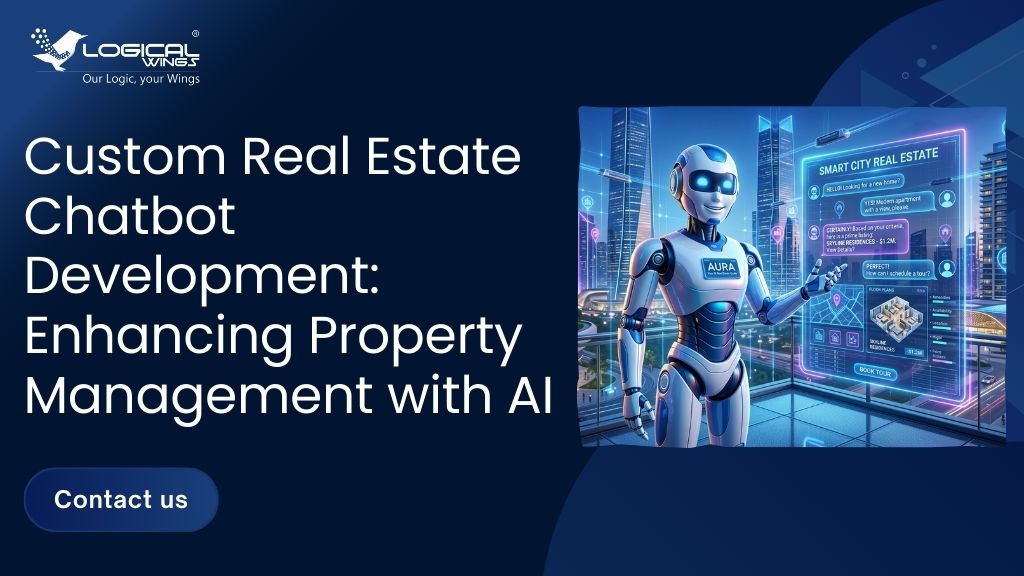
Custom Real Estate Chatbot Development: Enhancing Property Management with AI

The real estate industry is experiencing a seismic transformation driven by artificial intelligence, and at the forefront of this revolution are AI-powered chatbots and intelligent agents. In 2026, real estate professionals who leverage custom chatbot development are capturing 40% more leads, converting prospects at rates 5X higher than traditional methods, and delivering 24/7 customer experiences that were impossible just three years ago. According to recent market analysis, the AI real estate market has expanded from $222.7 billion in 2024 to $303.1 billion in 2025, reflecting a robust 36.1% compound annual growth rate. This explosive growth is driven by a fundamental shift in consumer behavior: 82% of Americans now use AI platforms like ChatGPT and Gemini for housing market insights, while 93% of homebuyers conduct their initial research online. For real estate businesses, this presents both an unprecedented opportunity and an urgent competitive imperative. Properties don’t sell themselves anymore — they’re discovered, evaluated, and shortlisted by AI-assisted buyers who expect instant responses, personalized recommendations, and seamless digital experiences. Real estate chatbots and AI agents have evolved from experimental novelties to mission-critical business infrastructure that directly impacts revenue, lead quality, and operational efficiency. What Is a Real Estate AI Agent? Understanding the Technology A real estate AI agent is an intelligent software system powered by artificial intelligence and natural language processing that can autonomously interact with property buyers, sellers, renters, and investors through conversational interfaces. Unlike traditional chatbots that follow rigid, pre-programmed decision trees, modern real estate AI agents leverage advanced machine learning models — including GPT-4, Claude, Gemini, and specialized industry-trained models — to understand context, interpret complex queries, and deliver personalized, human-like responses. Core Components of a Real Estate AI Agent Modern real estate chatbots are sophisticated systems comprised of multiple integrated technologies: • Natural Language Processing (NLP) engines that understand real estate terminology, local market nuances, and buyer intent across multiple languages • Machine Learning models trained on millions of real estate conversations to predict user needs and optimize response accuracy • Integration APIs connecting to MLS databases, CRM systems, property management platforms, scheduling calendars, and mortgage calculators • Conversational AI frameworks that maintain context across multi-turn dialogues and remember user preferences from previous interactions • Real-time data synchronization ensuring property availability, pricing, and listing details are always current • Multi-channel deployment capabilities enabling the same AI agent to operate across websites, mobile apps, WhatsApp, Facebook Messenger, SMS, and voice platforms. The Evolution: From Simple Chatbots to Intelligent Agents The distinction between basic chatbots and true AI agents is critical. First-generation real estate chatbots (2018-2021) could answer FAQs and collect contact information but required constant manual updates and couldn’t handle complex queries. Second-generation systems (2022-2024) introduced machine learning and limited personalization but struggled with conversational depth. Today’s third-generation real estate AI agents (2025-2026) represent a quantum leap in capability. They can conduct entire property consultations autonomously, qualify leads based on sophisticated financial and lifestyle criteria, provide neighborhood insights and market analysis, schedule property viewings by integrating with agent calendars, walk buyers through mortgage pre-qualification, remember client preferences across months of interaction, and even negotiate offers within pre-defined parameters. How AI Agents Benefit Real Estate Industries: Quantified Impact The business case for custom real estate chatbot development is no longer theoretical — it’s backed by extensive industry data demonstrating measurable ROI across multiple performance dimensions. Here’s how real estate AI agents deliver tangible value: 1. Dramatic Lead Generation and Conversion Improvements AI-powered chatbots enhance lead generation in real estate by 33% according to industry research. This improvement stems from several factors: instant engagement the moment a prospect lands on your website (before they bounce to a competitor), intelligent lead qualification that identifies high-intent buyers based on budget, timeline, and property preferences, and 24/7 availability ensuring no lead is lost due to timezone differences or after-hours inquiries. More importantly, real estate teams using AI chatbots see conversion rates increase by up to 40%. AI agents nurture leads through personalized follow-ups, automatically schedule property viewings when buyer interest peaks, provide instant answers to objections and concerns, and seamlessly hand off qualified prospects to human agents at the optimal moment. 2. Operational Cost Reduction Through Automation Chatbots in real estate can handle up to 80% of routine customer inquiries in top-tier firms, dramatically reducing the administrative burden on sales teams. This automation translates directly to cost savings: elimination of 24/7 customer service staffing requirements, reduction in time spent answering repetitive questions about properties, neighborhoods, and processes, and automated appointment scheduling eliminating phone tag and calendar management overhead. According to Gartner research, by 2025, 43% of customer service engagements will be handled by virtual agents or chatbots — a prediction that has proven accurate in forward-thinking real estate organizations. 3. Enhanced Customer Experience and Satisfaction In an era where buyers expect Amazon-level convenience, Real estate AI agents deliver experiences that were previously impossible: instant response times (within seconds, not hours or days), personalized property recommendations based on stated preferences and browsing behavior, proactive communication including price drop alerts, new listing notifications, and market updates, and multi-channel consistency whether clients engage via website, mobile app, WhatsApp, or Facebook. Harvard Business Review reports a 10% increase in customer retention rates for businesses using chatbots, driven by personalized interactions and timely support that build trust and loyalty. 4. Superior Data Collection and Business Intelligence Every conversation with a Real estate AI agent generates valuable data that informs business strategy. Modern chatbots automatically capture and structure: detailed buyer preferences (property type, location, budget, must-have features), behavioral patterns revealing which neighborhoods, price points, and amenities generate the most interest, engagement metrics showing which properties drive the longest conversations and highest inquiry rates, and market intelligence tracking frequently asked questions, common objections, and emerging trends. 74% of organizations using automated agents report improved data collection processes. This intelligence feeds directly into CRM systems, enabling targeted marketing campaigns, dynamic pricing strategies, and data-driven investment decisions. 5. Scalability During Peak Demand Periods Real estate markets experience extreme demand fluctuations — new

Custom Real Estate Chatbot Development: Enhancing Property Management with AI Read More »

AI Services
Scroll to Top