AI agents are not chatbots. A chatbot answers questions. An agent takes actions, browsing the web, writing and executing code, calling APIs, updating records, and triggering workflows based on a goal, not a script. That distinction matters when you’re evaluating vendors, because the failure modes are completely different.
A bad chatbot gives the wrong answer. A bad AI agent sends the wrong email to 10,000 customers, deletes the wrong database records, or places an unintended purchase order. The stakes are higher. So is the bar for the company you hire.
AI Agents Development Company
Hiring the right AI agents development company determines whether your automation investment pays off or stalls in a pilot that never scales. Unlike generic software vendors, a specialized AI agents development company builds systems that can reason, plan, and act across multiple steps — connecting to your CRM, ERP, helpdesk, or custom APIs to complete real workflows without a human directing every move. The gap between a company that has shipped production agents and one that’s still experimenting with demos is significant, and it shows up fast once you move past the proof-of-concept stage.
The best AI agents development companies bring three things to the table: deep orchestration experience, clean integration methodology, and a structured approach to failure handling. Orchestration is what separates a reliable agent from an unpredictable one — it governs how the agent breaks down a goal, which tools it calls, and what it does when something goes wrong mid-task. Companies that have built and maintained agents in production environments understand that edge cases aren’t rare. They’re the norm. Their architecture reflects that.
When evaluating an AI agents development company, prioritize vendors who start with a narrow, well-scoped pilot over those promising full enterprise automation from day one. A credible company will run discovery, map your existing systems, define escalation paths, and deliver a working pilot on a single high-value workflow before expanding scope. That’s not caution — that’s how production-grade agent deployments actually succeed. Ask for references from live deployments, not beta programs. Ask who owns the code after delivery. The answers will tell you everything about whether you’re talking to a company that builds for the long term or one that closes deals and moves on.
What Custom AI Agents Actually Do
Before evaluating vendors, get clear on what an agent is doing in your system.
Task automation agents execute multi-step workflows without human input, pulling data from one source, transforming it, and pushing it somewhere else. Think automated competitive research, lead enrichment pipelines, or invoice reconciliation.
Decision-support agents don’t act autonomously but surface recommendations fast enough to matter. A procurement agent that flags anomalous vendor pricing in real time, for example, or a support agent that drafts a resolution and routes it for one-click approval.
Autonomous action agents operate with minimal human oversight. They’re given a goal and a set of tools and expected to figure out the steps. These are the highest-leverage and highest-risk class of agents. Most enterprise deployments that call themselves “autonomous” are actually heavily supervised. That’s usually the right call.
Knowing which category you need determines whether you need a vendor with deep workflow orchestration experience, strong safety tooling, or both.
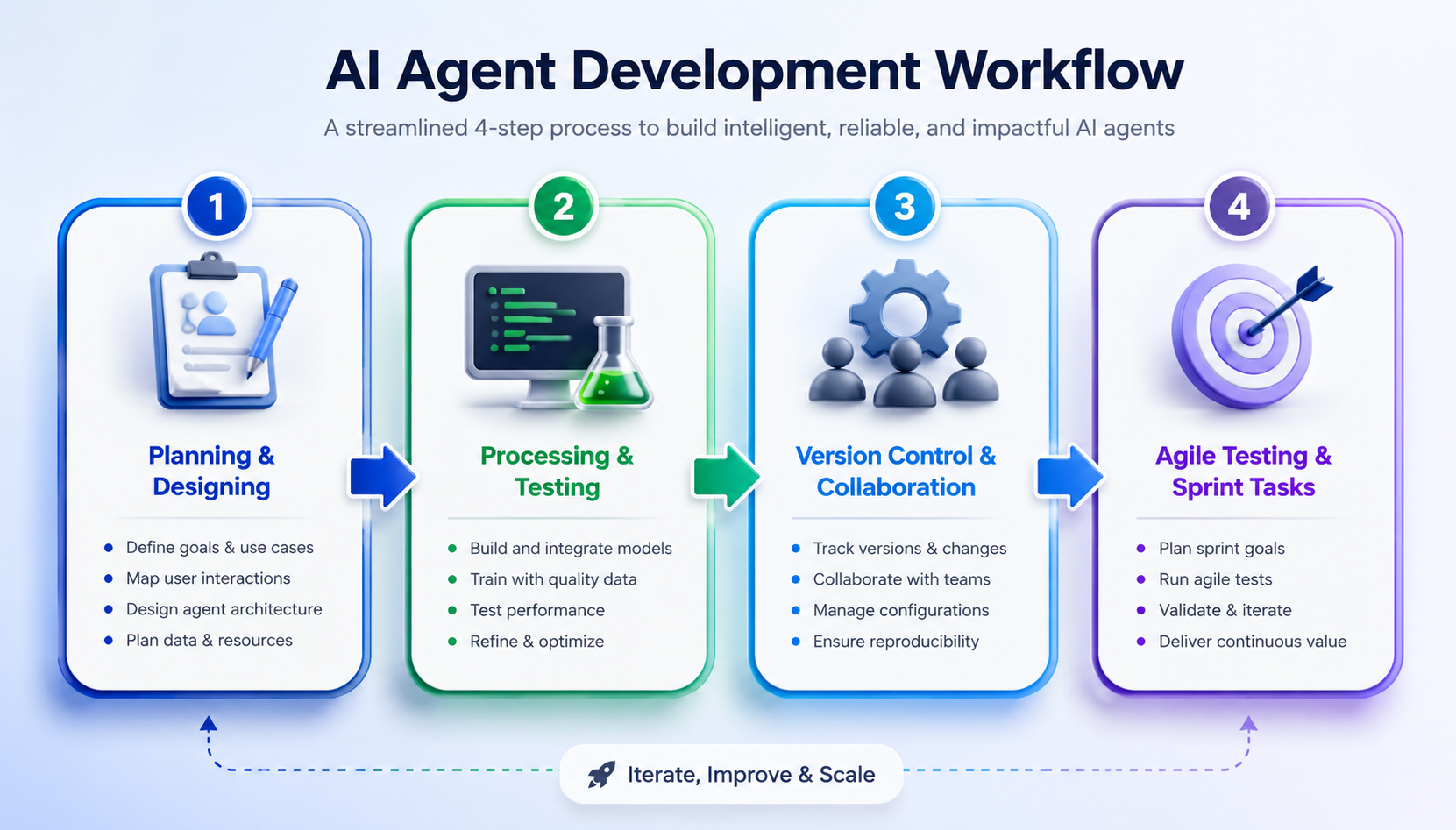
The Technical Stack That Separates Real Vendors from Demo Shops
Custom AI agent development isn’t prompt engineering. The vendors worth working with have solved harder problems.
Orchestration frameworks
Production agent systems need a layer that manages which tool the agent calls next, handles retries, and tracks state across a multi-step task. Ask vendors which frameworks they work with, LangGraph, CrewAI, AutoGen, or custom-built, and why. Vendors who can’t answer this question are building prototypes, not production systems.
Tool use and function calling
Agents operate through tools: APIs, code interpreters, web search, and database queries. A vendor’s ability to define clean tool schemas, handle malformed tool outputs gracefully, and rate-limit tool calls safely tells you a lot about their engineering maturity.
Memory architecture
Agents that operate over long sessions or across multiple tasks need memory for short-term context within a session, long-term storage across sessions, and sometimes shared memory across a team of agents. Ask how the vendor handles each layer. Many don’t have a clear answer.
Human-in-the-loop design
The best custom agent systems have explicit checkpoints where a human can review, correct, or override the agent before it takes an irreversible action. If a vendor’s architecture has no pause points, they’re building something you can’t safely trust.
Types of Custom AI Agent Development Companies
AI-Native Development Firms
These companies were built specifically around LLM-powered systems. They tend to have the most current knowledge of agent frameworks, model capabilities, and safety patterns. They also tend to be smaller and may not have enterprise procurement processes set up. Best for companies that want a technical partner, not a managed service.
Enterprise AI Consultancies
Larger firms, including offshoots of traditional tech consultancies that have added AI agent practices to their service portfolio. They bring project management discipline, compliance experience, and staffing scale. The risk is that their agent teams are newer and thinner than their marketing suggests. Ask specifically about agent deployment experience, not just AI experience broadly.
Vertical-Specific Builders
Studios that build exclusively within one industry: legal, healthcare, finance, logistics. If your use case lives in one of those verticals, a specialist almost always outperforms a generalist. They’ve handled the compliance constraints, the data formats, and the edge cases specific to your domain. Their bench is narrower, but their depth is real.
Platform Vendors with Agent Layers
Some SaaS companies have added agentic capabilities on top of existing products Salesforce Agentforce, ServiceNow, Microsoft Copilot Studio. If you’re already deep in one of these ecosystems, a platform-native agent can move faster to deployment. The trade-off: you’re building inside their walls. Customization past their supported patterns requires workarounds or isn’t possible at all.
Due Diligence Questions That Matter
Ask how they handle agent failures mid-task
If an agent is three steps into a five-step workflow and the API it depends on returns an error, what happens? Does it retry, escalate, roll back, or silently stop? A vendor without a clear answer hasn’t run an agent in production.
Ask for their approach to prompt injection
In agentic systems, malicious content in the environment, such as a webpage the agent reads or a document it processes, can hijack the agent’s behavior. This is a known attack vector. Vendors doing serious work have a mitigation strategy.
Ask what “done” looks like for evaluation
Chatbots can be evaluated on response quality. Agents need to be evaluated on task completion rate, error rate, latency, and cost per task. Ask vendors how they measure agent performance and what baselines they benchmark against.
Ask who gets paged when the agent does something wrong
Not when. Agents operating in production will eventually take an unintended action. Who monitors for that? Who has kill-switch access? What’s the incident response process?
Ask about cost controls
Agents that loop, retry excessively, or call expensive APIs repeatedly can generate surprising infrastructure costs. Serious vendors build token budgets, timeout limits, and cost alerts into their systems from the start.
What a Real Custom Agent Engagement Looks Like
Discovery (2–4 weeks)
Map the target workflow in detail. Identify every tool the agent needs, every decision point, and every place where human review is mandatory vs. optional. Vendors who skip this phase are guessing at your requirements.
Scoped prototype (4–6 weeks)
Build a working agent for one narrow workflow, not a demo, a real system connected to your staging environment. This is where you find out whether the vendor’s architecture assumptions match your infrastructure.
Supervised pilot (6–10 weeks)
Run the agent in production with a human reviewing every output before it takes effect. Collect failure cases. Measure task completion rate and error rate. Use this data to decide whether to expand the scope or tighten constraints.
Graduated autonomy
As confidence in the agent grows, reduce the human review requirement incrementally. Don’t start with full autonomy. Earn it through pilot data.
Projects that skip the supervised pilot phase and deploy autonomous agents directly to production have a poor track record. The technical system might work. The edge cases you didn’t think of will surface fast, and without a rollback process, they’ll cause real damage.
How to Evaluate a Custom AI Agents Development Company
Ask for a working demo in your environment, not theirs. Canned demos with clean data and predictable inputs tell you nothing about how the agent handles messy real-world conditions. If they can’t run a scoped proof-of-concept on a slice of your actual data and systems, that’s informative.
Check their orchestration depth. Can their agents handle mid-task failures gracefully? What happens when a tool call returns an unexpected format? How does the agent behave when it hits a decision point outside its training scope? These aren’t edge cases — they happen constantly in production.
Ask who owns the agent logic after delivery. Some vendors build on proprietary platforms that lock you in permanently. Others hand you portable code that your team can modify and extend. Know which one you’re buying before you sign.
Verify their security posture. Agents with write access to your systems need strict permission scoping, audit logging, and access controls. SOC 2 compliance is a baseline. Ask specifically how they handle credential management for tool integrations.
Look at their post-launch support model. Agents drift as the underlying systems they interact with change. APIs get updated, schemas shift, business rules evolve. A vendor with no structured maintenance offering is selling you a point-in-time solution, not a long-term capability.
Red Flags
“Fully autonomous” in the pitch deck
Autonomy is a dial, not a switch. Any vendor promising fully autonomous agents without discussing oversight, monitoring, and failure handling is selling you a prototype and calling it a product.
No discussion of agent safety
Prompt injection, runaway loops, unintended tool calls, and irreversible actions are known problems in agentic systems. If a vendor doesn’t bring these up, they haven’t shipped agents in production.
Demos that only show the success path
Every agent demo shows the happy path. Ask vendors to demo what happens when a tool returns an unexpected response, when the agent gets confused mid-task, or when a user asks the agent to do something outside its permitted scope.
Vague answers on data handling
Agents often touch sensitive data, customer records, financial documents, and internal communications. Understand exactly what data moves through the agent’s context window, where it’s logged, and who has access to those logs.
No ownership of the system post-deployment
Some vendors build and walk away. If you don’t have internal engineers who can monitor, debug, and retrain the agent system, you need a vendor with a managed service or an ongoing support contract. Clarify this before signing.
The Honest Bottom Line
Custom AI agent development is genuinely hard. The gap between a compelling demo and a reliable production system is wider here than almost anywhere else in software. Vendors who’ve closed that gap have scars to prove it: failed pilots, edge cases that broke things, and architectures they rebuilt.
The right vendor for your project has deployed agents in your industry, can describe their failure modes clearly, and has a monitoring and escalation process in place before the system goes live.
Define the workflow you need automated. Find a vendor that’s done it before. Run a supervised pilot with clear success metrics. Expand the scope only after the pilot earns it. The leverage from a well-built agent system is real. So is the downside from one that isn’t.
FAQ’s
Chatbot is reactive; it responds to what a user types. An AI agent is proactive and goal-driven. It can take a high-level objective, break it into steps, call external tools, make decisions along the way, and complete a task without a human directing each action. The practical difference: a chatbot tells you a flight is delayed; an agent rebooking your flight is an agent.
Scoped, single-workflow agent built on existing APIs typically takes 6–12 weeks from discovery to pilot launch. Multi-agent systems with complex integrations and custom orchestration logic run 4–6 months. Timelines stretch when integrations require legacy system work or when the use case isn’t well-defined going in. Any vendor quoting under four weeks for a production-ready agent on a complex workflow is underselling the problem.
Ballpark ranges vary widely by scope. A focused single-agent build with clean API integrations typically runs. Multi-agent systems with custom orchestration, enterprise integrations, and ongoing maintenance contracts. Platform-based solutions with limited customization cost less upfront but carry licensing fees and ceiling constraints. Get itemized quotes for discovery, build, integration, testing, and support, which should be line items, not bundled into a single number.
Yes, provided those systems have accessible APIs or data export capabilities. Most modern SaaS platforms (Salesforce, HubSpot, Jira, SAP, ServiceNow) are well-supported. Legacy systems without APIs require middleware or custom connectors, which adds time and cost. The integration audit maps what systems the agent needs to touch and how they should happen in discovery before any build begins.
The metrics that matter depend on the use case, but the core ones are: task completion rate (percentage of assigned tasks finished without human intervention), error rate (how often the agent takes a wrong action or produces an incorrect output), escalation rate (how often it hands off to a human and why), and time-to-completion compared to the manual baseline. Avoid measuring user satisfaction alone, it’s easy to game and doesn’t tell you if the agent is actually reliable.