
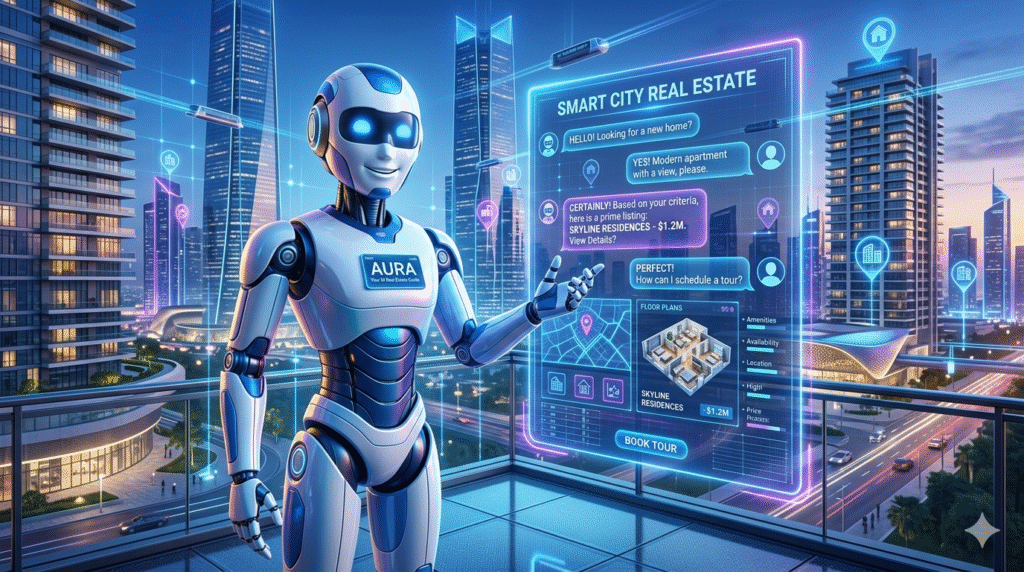
The real estate industry is experiencing a seismic transformation driven by artificial intelligence, and at the forefront of this revolution are AI-powered chatbots and intelligent agents. In 2026, real estate professionals who leverage custom chatbot development are capturing 40% more leads, converting prospects at rates 5X higher than traditional methods, and delivering 24/7 customer experiences that were impossible just three years ago.
According to recent market analysis, the AI real estate market has expanded from $222.7 billion in 2024 to $303.1 billion in 2025, reflecting a robust 36.1% compound annual growth rate. This explosive growth is driven by a fundamental shift in consumer behavior: 82% of Americans now use AI platforms like ChatGPT and Gemini for housing market insights, while 93% of homebuyers conduct their initial research online.
For real estate businesses, this presents both an unprecedented opportunity and an urgent competitive imperative. Properties don’t sell themselves anymore — they’re discovered, evaluated, and shortlisted by AI-assisted buyers who expect instant responses, personalized recommendations, and seamless digital experiences. Real estate chatbots and AI agents have evolved from experimental novelties to mission-critical business infrastructure that directly impacts revenue, lead quality, and operational efficiency.
What Is a Real Estate AI Agent? Understanding the Technology
A real estate AI agent is an intelligent software system powered by artificial intelligence and natural language processing that can autonomously interact with property buyers, sellers, renters, and investors through conversational interfaces. Unlike traditional chatbots that follow rigid, pre-programmed decision trees, modern real estate AI agents leverage advanced machine learning models — including GPT-4, Claude, Gemini, and specialized industry-trained models — to understand context, interpret complex queries, and deliver personalized, human-like responses.
Core Components of a Real Estate AI Agent
Modern real estate chatbots are sophisticated systems comprised of multiple integrated technologies:
• Natural Language Processing (NLP) engines that understand real estate terminology, local market nuances, and buyer intent across multiple languages
• Machine Learning models trained on millions of real estate conversations to predict user needs and optimize response accuracy
• Integration APIs connecting to MLS databases, CRM systems, property management platforms, scheduling calendars, and mortgage calculators
• Conversational AI frameworks that maintain context across multi-turn dialogues and remember user preferences from previous interactions
• Real-time data synchronization ensuring property availability, pricing, and listing details are always current
• Multi-channel deployment capabilities enabling the same AI agent to operate across websites, mobile apps, WhatsApp, Facebook Messenger, SMS, and voice platforms.
The Evolution: From Simple Chatbots to Intelligent Agents
The distinction between basic chatbots and true AI agents is critical. First-generation real estate chatbots (2018-2021) could answer FAQs and collect contact information but required constant manual updates and couldn’t handle complex queries. Second-generation systems (2022-2024) introduced machine learning and limited personalization but struggled with conversational depth.
Today’s third-generation real estate AI agents (2025-2026) represent a quantum leap in capability. They can conduct entire property consultations autonomously, qualify leads based on sophisticated financial and lifestyle criteria, provide neighborhood insights and market analysis, schedule property viewings by integrating with agent calendars, walk buyers through mortgage pre-qualification, remember client preferences across months of interaction, and even negotiate offers within pre-defined parameters.
How AI Agents Benefit Real Estate Industries: Quantified Impact
The business case for custom real estate chatbot development is no longer theoretical — it’s backed by extensive industry data demonstrating measurable ROI across multiple performance dimensions. Here’s how real estate AI agents deliver tangible value:
1. Dramatic Lead Generation and Conversion Improvements
AI-powered chatbots enhance lead generation in real estate by 33% according to industry research. This improvement stems from several factors: instant engagement the moment a prospect lands on your website (before they bounce to a competitor), intelligent lead qualification that identifies high-intent buyers based on budget, timeline, and property preferences, and 24/7 availability ensuring no lead is lost due to timezone differences or after-hours inquiries.
More importantly, real estate teams using AI chatbots see conversion rates increase by up to 40%. AI agents nurture leads through personalized follow-ups, automatically schedule property viewings when buyer interest peaks, provide instant answers to objections and concerns, and seamlessly hand off qualified prospects to human agents at the optimal moment.
2. Operational Cost Reduction Through Automation
Chatbots in real estate can handle up to 80% of routine customer inquiries in top-tier firms, dramatically reducing the administrative burden on sales teams. This automation translates directly to cost savings: elimination of 24/7 customer service staffing requirements, reduction in time spent answering repetitive questions about properties, neighborhoods, and processes, and automated appointment scheduling eliminating phone tag and calendar management overhead.
According to Gartner research, by 2025, 43% of customer service engagements will be handled by virtual agents or chatbots — a prediction that has proven accurate in forward-thinking real estate organizations.
3. Enhanced Customer Experience and Satisfaction
In an era where buyers expect Amazon-level convenience, Real estate AI agents deliver experiences that were previously impossible: instant response times (within seconds, not hours or days), personalized property recommendations based on stated preferences and browsing behavior, proactive communication including price drop alerts, new listing notifications, and market updates, and multi-channel consistency whether clients engage via website, mobile app, WhatsApp, or Facebook.
Harvard Business Review reports a 10% increase in customer retention rates for businesses using chatbots, driven by personalized interactions and timely support that build trust and loyalty.
4. Superior Data Collection and Business Intelligence
Every conversation with a Real estate AI agent generates valuable data that informs business strategy. Modern chatbots automatically capture and structure: detailed buyer preferences (property type, location, budget, must-have features), behavioral patterns revealing which neighborhoods, price points, and amenities generate the most interest, engagement metrics showing which properties drive the longest conversations and highest inquiry rates, and market intelligence tracking frequently asked questions, common objections, and emerging trends.
74% of organizations using automated agents report improved data collection processes. This intelligence feeds directly into CRM systems, enabling targeted marketing campaigns, dynamic pricing strategies, and data-driven investment decisions.
5. Scalability During Peak Demand Periods
Real estate markets experience extreme demand fluctuations — new development launches, seasonal buying patterns, interest rate changes. AI chatbots manage thousands of conversations simultaneously across channels, making them ideal during peak buying seasons or large property launches. Unlike human teams that require months to hire and train, AI agents scale instantly to handle 10X or 100X traffic spikes without degradation in response quality or speed.
How Is AI Used in the Real Estate Industry? Comprehensive Applications
AI chatbot development companies have created specialized solutions for virtually every aspect of the real estate value chain. Here are the most impactful applications transforming the industry in 2026:
Property Search and Discovery
Real estate AI agents revolutionize how buyers find properties by analyzing natural language queries like ‘Show me family-friendly 4-bedroom homes near good schools under $600K’ and instantly returning matching listings from integrated MLS databases. They use collaborative filtering algorithms to recommend properties based on viewing history and preferences similar to how Netflix recommends shows, proactively suggest properties when new listings match saved search criteria, and provide neighborhood insights including school ratings, crime statistics, commute times, and local amenities.
Lead Qualification and Nurturing
Intelligent chatbots in real estate automatically qualify leads by asking targeted questions about budget, timeline, financing pre-approval status, must-have features, and deal-breaker constraints. They assign lead scores based on readiness to buy, enabling agents to prioritize high-value opportunities. The AI nurtures prospects over weeks or months through personalized email drip campaigns, SMS notifications about relevant new listings, market updates and neighborhood reports, and gentle reminders to schedule property viewings.
Appointment Scheduling and Calendar Management
Real estate chatbots integrate directly with agent calendars to automate the entire scheduling process. When a prospect requests a property showing, the AI checks agent availability, proposes multiple time slots, confirms the appointment via email and SMS, sends calendar invites to both parties, and automatically handles rescheduling requests. This eliminates the back-and-forth that typically costs 5-10 emails or phone calls per showing.
Virtual Property Tours and Staging
Advanced AI agents in real estate now facilitate immersive experiences: virtual tour coordination where chatbots send 3D walkthrough links and guide users through interactive property explorations, AI-enhanced virtual staging showing properties with different furniture arrangements and design styles, and architectural visualization helping buyers understand renovation potential and space utilization.
According to market research, AI-enhanced virtual staging increases property inquiries by up to 200% compared to traditional methods, while reducing the time properties spend on the market.
Mortgage and Financing Assistance
Real estate AI agents partner with mortgage lenders to guide buyers through pre-qualification: collecting financial information (income, employment, credit score ranges, down payment capacity), calculating affordability and estimated monthly payments, explaining different mortgage products (FIX, ARM, FHA, VA loans), and connecting qualified buyers with mortgage specialists for formal applications.
Companies like Rocket Mortgage already use conversational AI assistants to guide users through mortgage pre-qualification
online, dramatically accelerating applications and improving completion rates.
Tenant Screening and Property Management
Property managers use AI agents to automate tenant interactions: initial inquiry response and pre-qualification, lease application collection and document verification, maintenance request intake and categorization, rent payment reminders and late payment follow-up, and lease renewal outreach and negotiation. This automation reduces property management overhead by 20-30% while improving tenant satisfaction through faster response times.
Custom Real Estate Chatbot Development: Building Your Competitive Advantage
While off-the-shelf chatbot platforms offer basic functionality, leading real estate firms are investing in custom AI agent development services to create proprietary systems tailored to their specific business models, property types, and competitive positioning. Here’s what distinguishes custom development:
Strategic Customization Opportunities
Custom real estate chatbots can be purpose-built for your exact requirements: integration with your specific MLS, CRM, and property management platforms, brand voice and personality aligned with your company’s market positioning, specialized knowledge bases covering your geographic markets, neighborhoods, and property types, custom lead qualification logic based on your sales process and agent capacity, and unique features differentiating you from competitors (e.g., instant property valuation, AI-generated investment analysis).
Technology Stack Considerations
Leading AI chatbot development companies build real estate solutions using cutting-edge technology stacks: large language models including GPT-4, Claude 3, Google Gemini, IBM Watsonx, or fine-tuned open-source models like Llama, vector databases for semantic search across property listings and knowledge bases, conversation management frameworks tracking context across multi-turn dialogues, real-time integration middleware connecting to MLS APIs, calendar systems, and CRM platforms, and deployment infrastructure supporting web, mobile, WhatsApp, Facebook Messenger, SMS, and voice channels.
Development Process and Timeline
Custom real estate AI agent development typically follows a structured methodology: discovery and requirements gathering (2-3 weeks), data integration and knowledge base construction
(3-4 weeks), AI model training and conversation design (4-6 weeks), integration development and testing (3-4 weeks), pilot deployment and refinement (2-3 weeks), and full launch and ongoing optimization. Total project timelines range from 12-20 weeks depending on complexity.
Cost Considerations and ROI
Real estate AI chatbot development costs vary significantly based on functionality required. Basic chatbots offering lead generation and customer support range from $10,000 to $20,000. Advanced systems with virtual tours, calendar integration, MLS synchronization, and multi-channel deployment
However, the ROI calculation is compelling. A mid-size real estate firm spending on custom chatbot development typically sees: 25-40 additional qualified leads per month , 3-5 additional closed transactions annually and Operational cost savings from automation.
Selecting the Right AI Chatbot Development Company
Choosing the right AI agent development services partner is as critical as the decision to invest in custom development. Here’s what to evaluate:
Essential Selection Criteria
• Real estate industry expertise: Look for companies with demonstrated success building chatbots specifically for real estate, not generic chatbot builders
• Technical capabilities: Verify proficiency with modern AI technologies (GPT-4, Claude, fine-tuning, RAG architectures, vector databases)
• Integration experience: Ensure the company has integrated with major MLS platforms, CRMs (Salesforce, HubSpot, Follow Up Boss), and calendar systems
• Deployment flexibility: Confirm capability to deploy across web, mobile, WhatsApp, Facebook, SMS, and voice channels
• Ongoing support and optimization: Evaluate post-launch support models, monitoring capabilities, and continuous improvement processes• Data security and compliance: Verify adherence to data protection
regulations (GDPR, CCPA) and real estate industry standards
Red Flags to Avoid
• Companies promising ‘fully autonomous’ AI agents without human oversight mechanisms
• Vendors offering unrealistically fast timelines (quality AI development requires 10-20 weeks minimum)
• Chatbot builders with no real estate portfolio or industry case studies
• Platforms that lock you into proprietary systems with high ongoing fees and no data portability
• Developers unable to explain their AI architecture, model choices, or optimization methodologies
Frequently Asked Questions (FAQ)
Q: What is a real estate AI agent?
Ans : A real estate AI agent is an intelligent software system powered by artificial intelligence, machine learning, and natural language processing that autonomously interacts with property buyers, sellers, renters, and investors through conversational interfaces.
Q: How do AI Agents benefit real estate industries?
Ans : AI agents deliver quantifiable benefits across multiple dimensions of real estate business performance. First, they dramatically improve lead generation and conversion.
Q: How is AI used in the real estate industry?
Ans : AI is transforming virtually every aspect of the real estate value chain through sophisticated applications that were impossible just a few years ago. In property search and discovery, AI agents analyze natural language queries to instantly return matching listings from MLS databases, recommend properties using collaborative filtering algorithms similar to Netflix, and provide comprehensive neighborhood insights including schools, crime rates, and amenities.
Conclusion: Your Roadmap to AI-Powered Real Estate Success
The evidence is overwhelming: custom real estate chatbot development is no longer a futuristic luxury — it’s a competitive necessity for firms serious about growth in 2026 and beyond. With 82% of consumers using AI for housing insights, 93% conducting initial research online, and AI-powered lead conversion rates running 5X higher than traditional methods, the businesses that will dominate the next decade are those building intelligent, automated systems today.
Let’s Connect us: +1 (518) 284 3573
Address: S.T.E.A.M. Building, 279 Central Avenue, Albany, New York 12206.