
The healthcare industry is undergoing rapid digital transformation. From telemedicine to AI-driven diagnostics, innovation continues to reshape how care is delivered. Among these advancements, voice technology is emerging as a powerful tool that enhances patient engagement while significantly improving clinical workflows.
As healthcare organizations invest in custom healthcare solutions, integrating voice-enabled systems into digital platforms is becoming a strategic priority. Combined with healthcare mobile app development, voice technology is redefining patient interaction, documentation efficiency, and operational productivity.
What Is Voice Technology in Healthcare?
Voice technology in healthcare refers to AI-powered systems that enable voice recognition, speech-to-text transcription, and conversational interfaces within clinical and patient-facing applications. These systems allow users to interact with healthcare platforms using natural speech rather than manual input.
In modern healthcare mobile app development, voice technology can be integrated into:
- Patient engagement apps
- Telemedicine platforms
- Electronic Health Record (EHR) systems
- Remote patient monitoring solutions
- Virtual health assistants
By embedding voice interfaces into digital systems, healthcare providers can deliver faster, more intuitive, and accessible care experiences.
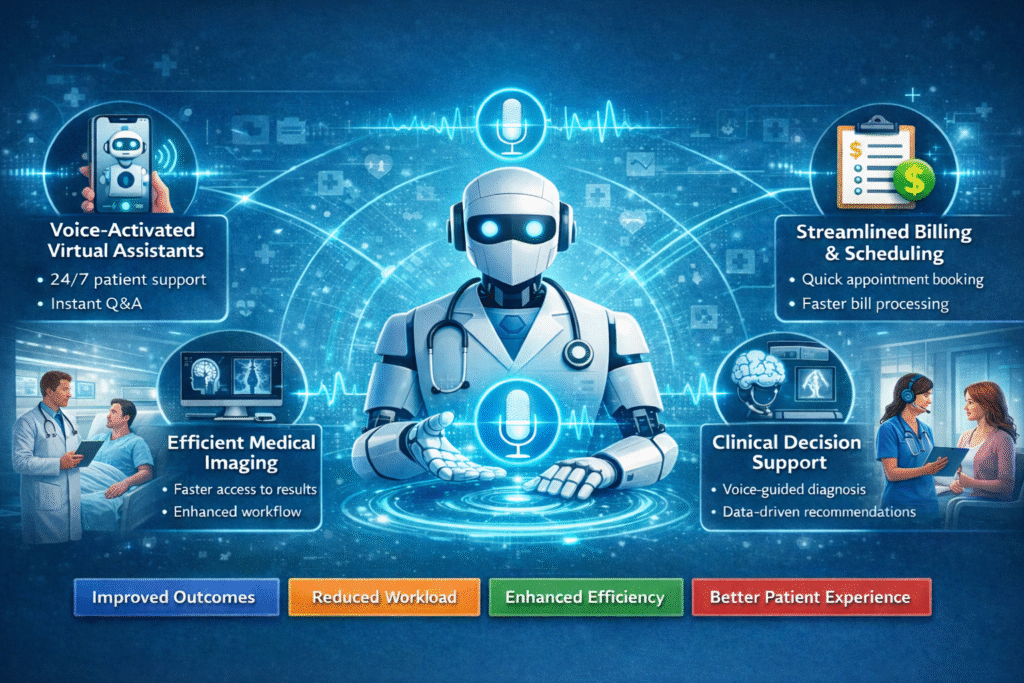
Enhancing Patient Experience Through Voice Technology
1. Simplified Appointment Scheduling
Voice-enabled apps allow patients to schedule, reschedule, or cancel appointments using simple spoken commands. This reduces friction and improves access to care, particularly for elderly or less tech-savvy users.
2. Medication Reminders and Chronic Care Support
Voice-powered healthcare applications can:
- Provide medication reminders
- Offer dosage instructions
- Answer basic health-related queries
- Monitor chronic conditions
This improves adherence rates and empowers patients to take an active role in their health management.
3. Improved Accessibility
Voice technology plays a critical role in making healthcare inclusive. Patients with visual impairments, mobility challenges, or limited literacy can interact with applications hands-free. Multilingual voice assistants also bridge communication gaps in diverse patient populations.
4. Enhanced Telehealth Experiences
In telemedicine platforms, voice-enabled features streamline patient intake, symptom reporting, and follow-up instructions, creating a smoother virtual care journey.
When implemented as part of custom healthcare solutions, voice capabilities significantly elevate the overall patient experience.
Improving Clinical Efficiency and Workflow
While patient experience is vital, voice technology’s impact on clinical efficiency is equally transformative.
1. Automated Clinical Documentation
Physicians spend a considerable portion of their day on documentation. Voice-enabled speech-to-text systems allow providers to dictate notes directly into EHR systems in real time. This:
- Reduces administrative burden
- Minimizes documentation errors
- Saves valuable time
- Enhances accuracy
2. Reduced Physician Burnout
Administrative overload is a leading cause of clinician burnout. By automating repetitive documentation tasks, voice technology allows providers to focus more on patient care rather than manual data entry.
3. Faster Data Retrieval
Clinicians can use voice commands to retrieve patient records, lab results, or imaging reports instantly. This accelerates decision-making and improves workflow efficiency during consultations.
4. Streamlined Clinical Communication
Voice-powered internal systems can assist with task reminders, shift updates, and care coordination, improving team collaboration across departments.
When developed by an experienced healthcare app development company, these voice-enabled systems integrate seamlessly into existing healthcare infrastructure.
The Role of a Healthcare App Development Company
Successfully implementing voice technology in healthcare requires deep industry expertise. A specialized healthcare app development company ensures:
- HIPAA-compliant app development
- Secure voice data encryption
- Seamless EHR/EMR integration
- Scalable cloud-based infrastructure
- AI-powered analytics integration
Healthcare organizations need tailored, secure, and regulation-compliant systems. Off-the-shelf solutions often fail to meet complex clinical requirements. This is where custom healthcare solutions become critical.
A strategic technology partner can design voice-enabled healthcare applications that align with specific operational workflows and patient engagement goals.
Voice Technology in Healthcare Mobile App Development
Modern healthcare mobile app development is no longer limited to appointment booking or video consultations. Voice-enabled mobile applications now support:
- Remote patient monitoring
- AI-based symptom checking
- Virtual nursing assistants
- Post-discharge care management
- Real-time health updates
For example, a patient managing diabetes can verbally log glucose levels, receive instant feedback, and share data with their physician — all through a voice-powered interface.
Integrating voice functionality into mobile health apps improves usability while increasing patient adoption rates. It also supports scalable digital health ecosystems that grow alongside organizational needs.
Security, Compliance, and Integration Considerations
Despite its advantages, implementing voice technology in healthcare requires careful planning.
1. Data Privacy and Security
Healthcare data is highly sensitive. Voice recordings and transcripts must be encrypted and stored securely to maintain HIPAA compliance.
2. Accuracy and Reliability
Clinical environments demand high recognition accuracy. Advanced AI models must be trained to understand medical terminology, accents, and contextual nuances.
3. System Integration
Voice systems must integrate seamlessly with existing EHRs, hospital management systems, and patient portals without disrupting workflows.
Partnering with a trusted healthcare app development company ensures these challenges are addressed through robust architecture and compliance-driven development.
The Future of Voice Technology in Healthcare
The future of voice technology in healthcare is promising. Advancements in AI and machine learning are making voice systems more intelligent and context-aware.
Emerging trends include:
- Predictive analytics powered by voice data
- AI-driven clinical decision support
- Personalized patient engagement tools
- Smart hospital rooms with voice-controlled systems
- Conversational AI for behavioral health support
As digital health continues to evolve, voice-enabled platforms will become a standard feature of custom healthcare solutions.
Healthcare organizations that invest in advanced healthcare mobile app development today position themselves for long-term innovation, operational efficiency, and improved patient outcomes.
Conclusion
Voice technology is transforming the healthcare industry by bridging the gap between patient engagement and clinical efficiency. From automating documentation to enhancing accessibility and telehealth experiences, voice-enabled systems are redefining modern care delivery.
By collaborating with an experienced healthcare app development company, healthcare providers can implement secure, scalable, and compliant custom healthcare solutions that integrate advanced voice technology into their digital ecosystem.
The future of healthcare is not just digital — it’s conversational, intelligent, and voice-enabled.
Let’s Connect us: +1 (518) 284 3573
Address: S.T.E.A.M. Building, 279 Central Avenue, Albany, New York 12206.
